
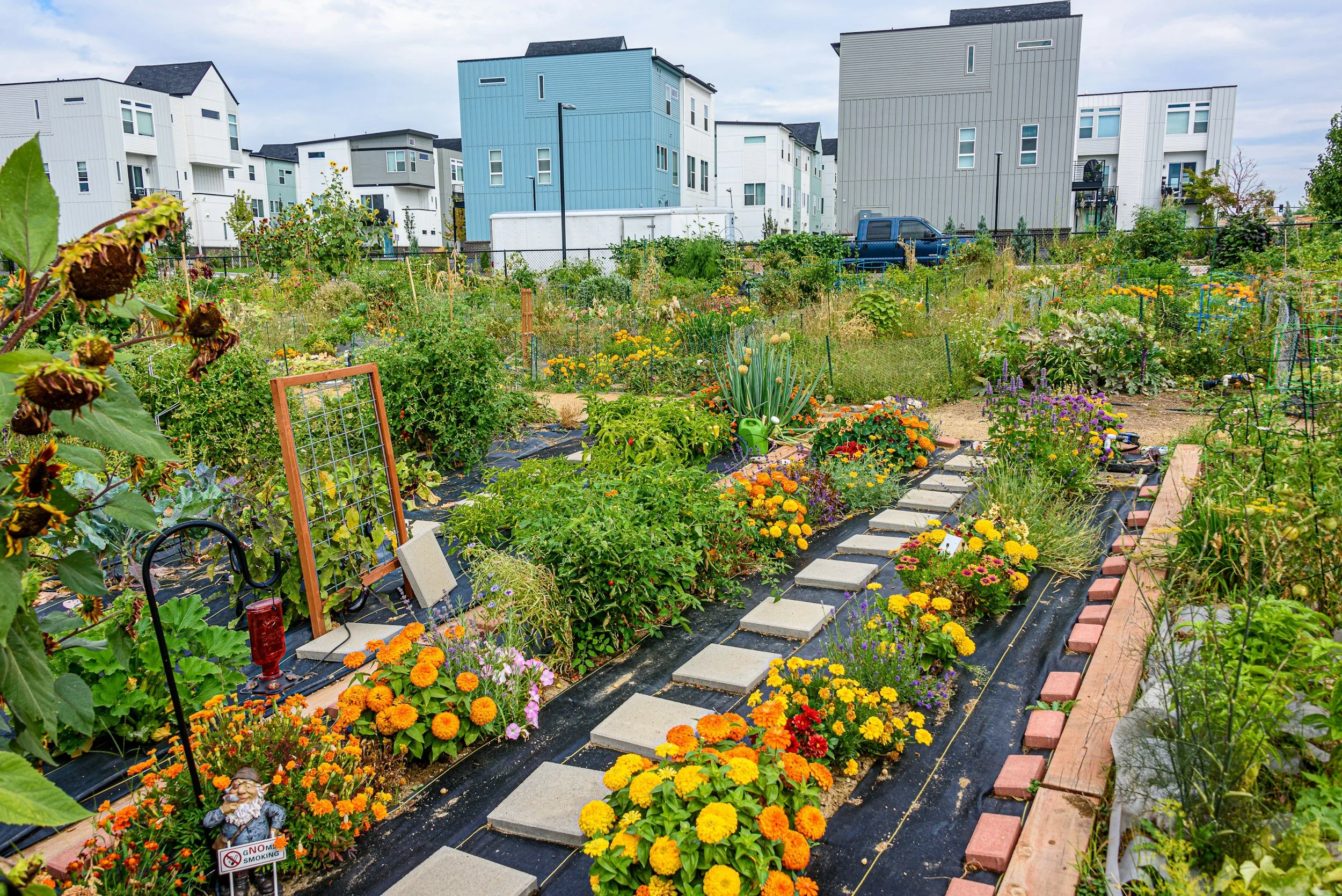
Resilience Hubs are built with communities, not for them.
A resilience hub is a community-centered space designed to support neighborhoods in everyday life and in preparing for, responding to, and recovering from disruptions to daily life such as heat waves, flooding, severe storms, public health emergencies, prolonged power outages, and other crises.
Resilience hubs are more than emergency shelters. They are trusted, physical spaces—often an existing community center, place of worship, school, or even library—that provide power, connectivity, and critical services during emergencies, while also serving the neighborhood every single day. They form a foundation for long-term resilience by strengthening community care and belonging, and enhancing disaster and climate preparedness. Done well, a hub isn't a facility that sits waiting for a disaster; it's a place people already know, already use, and already trust.
Table of Contents
Phases of Design and Development:
This guide is meant to be a reference you return to, not just a one-time read. Where should you start?
New to this entirely? Start with Readiness & Community Fit.
Already have a coalition and trust built, but no site? Jump to Assessment & Site Selection.
Already operating out of a space? Planning is likely your next step.
This framework is informed by resources from the Resilience Hub Collaborative and Kristin Baja’s guidance, the USDN Resilience Hub Guide, Collective Resilience’s Getting Started guide, and more. A full list of our references can be found at the bottom of the page.
Using this guide
This guide walks through the process of developing what's often called a "full-service" resilience hub.
It follows the model developed by Kristin “Baja” Baja, founder of the Resilience Hub Collaborative, which was most extensively captured in the Urban Sustainability Directors Network guide. It's written for community-based organizations, resident coalitions, faith communities, and other local partners who are considering leading a resilience hub effort in their neighborhood. While the process here applies broadly, the examples and hazards we highlight lean toward what communities across New England tend to face: winter storms, coastal and river flooding, and increasingly severe heat waves.
However, full-service is not the only option, and for many groups it isn't feasible right away, or maybe ever. Organizations like Collective Resilience describe resilience hubs on a continuum, from "emerging" hubs that offer a handful of core services to full-service hubs with robust backup power, staffing, and programming. If your organization can't do everything in this guide right away, don’t worry. It’s common, and it doesn't mean you can't start. Most hubs grow into their full vision over years, not months.
This is also work Climable does directly. We partner with community organizations at every stage of this process, from helping assess readiness to facilitating community engagement, navigating funding, and in some cases leading the project alongside a local partner. This guide reflects what we've learned doing that work, and if any part of it raises questions specific to your community, we'd welcome the chance to talk it through together.
Here is an overview of the following sections:
PHASE
1:
Building trust and understanding local hazards before anything else.
2:
Deciding who leads, and lining up the partners you'll need.
3:
Finding and evaluating a building, if you don't already have one.
4:
Determining protocols and offerings under normal, disruption, and recovery modes.
WHAT IT COVERS
5:
Sequencing funding needs from planning through equipment costs.

6:
Prepping the site and procuring backup power systems, communication devices, and supplies.

7:
Opening days as a resilience hub; activation, drills, and everyday communication.

8:
Evaluation, long-term funding, and growth over time.
For a deeper look at each phase, continue reading below.
There are helpful navigation buttons at the top of this page that will take you to any phase you’re interested in, or peruse the entire guide by scrolling down. There are hyperlinks throughout and at the bottom of the page that can provide additional support and context. If you have any questions, don’t hesitate to reach out.
Phase One: Readiness & Community Fit
Before you consider any hardware upgrades or even your site, the real question is whether your organization, group, or coalition has what a hub actually depends on: trust. A resilience hub only works during a crisis if people already believe it's for them, and that belief isn't built during an emergency. It's built over years of everyday presence.
Start by getting honest about your local hazards. Is your community most vulnerable to winter storms and cold-related outages, flooding, extreme heat, or some combination? Use online tools and expert input as needed. But also, talk to residents directly, through surveys, listening sessions, or just conversations at existing programming, rather than assuming you already know the priorities. What people fear and what planners assume are often different things.
This is where community engagement should take root, not as a task to complete but as the foundation from which the rest of the process builds. A hub developed through genuine resident input, from day one, will look different and be trusted more than one designed for a community with only cursory or no involvement. That means going beyond a single public meeting: it looks like recurring conversations, feedback loops that residents can see acted on, and involving people who are already trusted messengers in the neighborhood, such as a longtime church leader, a tenant association, or a local mutual aid group.
It also means asking who tends to be left out of planning processes like this one, and being deliberate about reaching them. Older adults, people with disabilities, non-English speakers, youth, and low-income renters are often the residents most affected by the hazards a hub is meant to address, and also the ones least likely to show up to a standard evening meeting. If your outreach only reaches the people who already have time and access to attend public meetings, it isn't yet reaching the community. Climable can work with you to create specific outreach and engagement strategies for the “hard-to-reach” groups in your community.
It's also important to ask whether now is the right time to begin developing a resilience hub. Signs you might not be ready yet:
No organization in the coalition has an established relationship with the neighborhood
There's no shared sense of which hazards matter most locally
The group hasn't yet talked with residents about whether a hub is even wanted
None of these are permanent barriers. But they must be addressed before any other planning and preparation work, not after.
Phase Two: Governance & Partnerships
A hub needs a clear structure for making decisions during planning and later during an actual emergency. Many hubs form a steering committee or advisory body that includes the lead organization, key partners, and residents themselves. Building resident seats into that structure from the start is one of the clearest ways to ensure people the hub serves also help run it. Write this as a requirement into any rules or bylaws, to protect community involvement into the future.
Governance also means defining your relationship to local government, emergency management, and other community support organizations, even if that relationship is informal at first. Does your city or town have an existing resilience hub program you'd be joining, or are you building something independent that will eventually need to coordinate with official emergency response? Either path is workable, but it changes what kind of agreements you'll need.
As plans firm up, expect to navigate memoranda of understanding with various entities, such as the building owner (if it's not your own space), as well as basic liability questions and insurance considerations. These don't need to be resolved on day one, but they should not be an afterthought either. Flag them early so they don't stall momentum later.
The partners you need often shift between building the hub and running it:
During development, you'll likely need:
Trusted community messengers to lead outreach and engagement
A building owner or facilities partner (if the space isn't yours)
Local emergency management or city resilience staff, even informally
Technical experts for site assessment and backup power planning
Funders or fiscal sponsors to support planning-stage costs
Other resilience hubs, locally or elsewhere, as a source of shared learning
During ongoing operation, you'll likely need:
Volunteers and/or staff to keep the hub running day-to-day
Nearby hospitals, schools, or social service agencies for referrals and coordination
Other community-based organizations for cross-programming and service offering
Utilities, for both backup power coordination and potential funding
Funders or fiscal sponsors to fund operating and management costs
Other resilience hubs, locally or elsewhere, as a source of shared learning
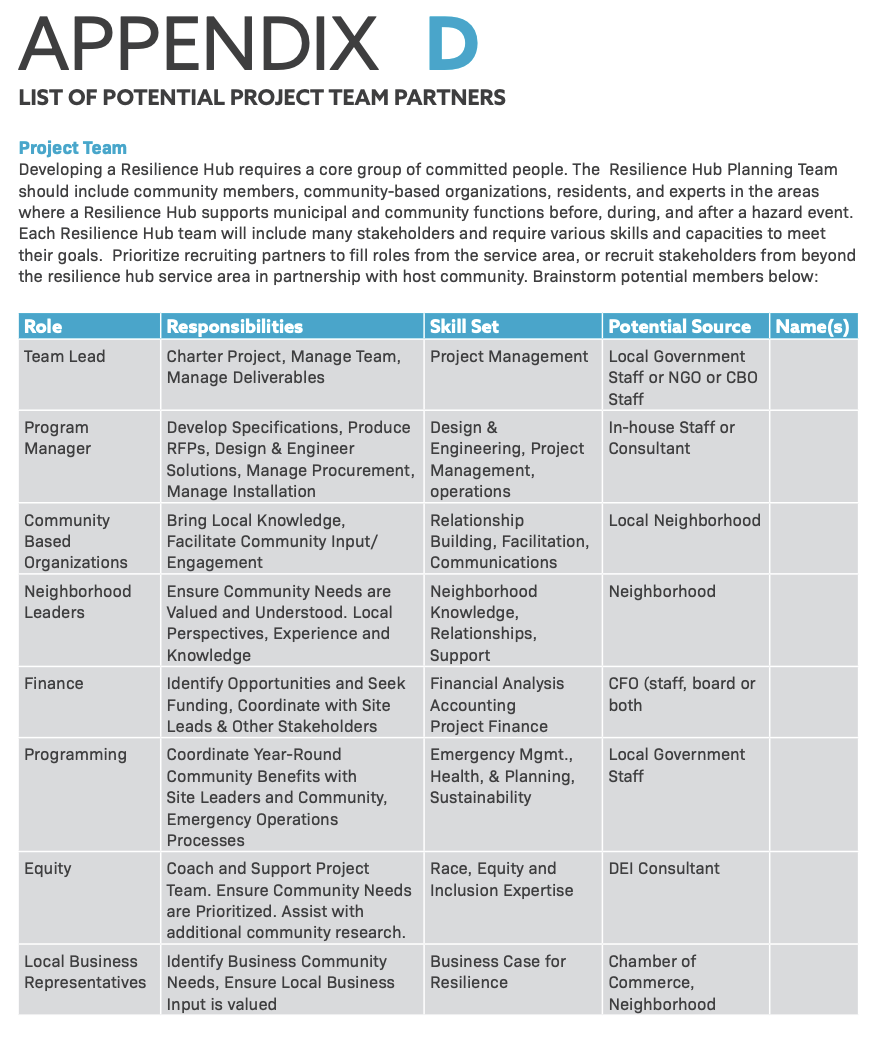
None of this needs to be formalized right away, but knowing who's out there before you need them saves real time later. A useful early exercise is building a simple community asset map—a working list of the organizations, informal networks, and trusted individuals already active in your neighborhood, and where each might fit into the hub's development or operation. It doesn't need to be sophisticated; a shared document that grows as you meet people is enough to start. Additionally, the Urban Sustainability Directors Network offers a great overview of potential project partners and team roles in their Resilience Hub Guidance Document (pages 20-22 and 76-78).
Phase Three: Site Selection & Feasibility Assessment
This section is primarily geared toward groups and coalitions that don't yet have a site in mind. If your organization has identified or already operates out of a space you're confident could serve as a hub, some of this may still be useful for confirming fit.
Site selection is often where groups without a space want to start, but it works better as step three because by now, you know your hazards, your governance structure, your community’s priorities, and who's at the table. That context makes evaluating a building far more concrete.
Look first at existing community anchors: community centers and houses of worship are ideal, but other locations can also be considered, such as schools and libraries. These may narrow what programs and services can be offered across operating modes, and who can access the hub. We strongly encourage you to consider existing facilities before new construction. Existing spaces come with two advantages a new building can't easily replicate: people already go there, and they're often already funded and staffed for everyday use. Retrofitting a trusted space is often more realistic and effective than building something new from scratch.
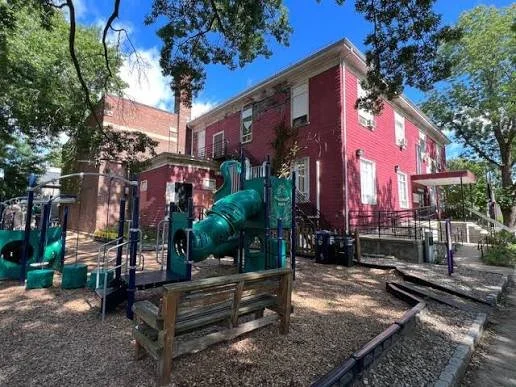
From there, assess suitability directly: Is the building accessible to people with disabilities and older adults? Does it have the physical capacity to host both everyday programming and, during a crisis, a larger influx of people needing shelter, charging, or services? And critically, is the site itself exposed to the hazards you're planning for? A hub in a flood zone or an area prone to power loss for extended periods needs a harder look before you commit.
Practical building questions matter more than they might seem at first: Is there adequate parking or transit access for people arriving during an emergency? Is the electrical system able to support added backup power infrastructure, or would that require costly upgrades? Are there working restrooms, a kitchen or food storage area, and enough open space to accommodate cots or gathering areas if needed? None of these have to be perfect on day one, but they shape both your budget and your timeline, so it's better to know the gaps early than to discover them mid-retrofit.
It's also worth weighing ownership and control. A hub in a building your organization owns or leases long-term gives you more say over retrofits and scheduling; a hub in a partner-owned space (a school, a municipal building) may come with more resources but less flexibility. Neither is wrong, it's just a tradeoff worth thinking through together, early.
Once you’ve identified one or more potential resilience hub sites, this could be a good time to have a solar and battery storage feasibility study done, in preparation for Phase Six: Physical & Technical Readiness. Climable can help navigate feasibility studies, including funding them.
Phase Four: Planning: Services & Operating Model
One of the defining features of a good resilience hub is that it isn't dormant most of the year. The everyday version of your hub—a place for classes, community meetings, cooling on hot days, or simply gathering—is what builds the trust and familiarity that make the emergency version work when it's needed.
As a reminder, following the Resilience Hub Collaborative’s model, planning should be done for three distinct modes of operation:
Normal mode: the hub's everyday function — regular programming, community gathering, services that make it a familiar part of the neighborhood and meet everyday needs
Disruption mode: how the hub operates during an active crisis or emergency — activation, expanded services, and support for residents in immediate need
Recovery mode: often overlooked, this is how the hub supports the community in the weeks and months after a disruption, as people rebuild — a role distinct from either day-to-day operation or the acute emergency response
Be specific about how the hub transitions between these three modes: who has the authority to activate and later stand down each one, and what programs and services shift as it moves from one mode to the next. Ensure the results of any feasibility assessment or other analysis are included in this planning process. Overpromising services you can't sustain in any single mode is a common and avoidable mistake.
Community members should be directly involved in this planning. Involve them from the start, rather than finalizing the operating model and presenting it afterward. Residents often have the clearest sense of what they'd actually need during a disruption or while recovering from one. This input is easy to miss if planning happens only among staff and partners.
Staffing is the backbone of all three modes. Decide early whether the hub will rely on paid staff, trained volunteers, or some mix, and be realistic about what's sustainable long-term versus what only works with a single dedicated person who may not always be available. Document as much as possible for redundancy.
It helps to write down, concretely, what a normal day looks like, what a disruption day looks like, and what recovery looks like in the weeks after, side by side. Who unlocks the doors? Who's trained to run the backup power system? Who checks in on older or disabled residents who may not come to the hub on their own, especially during recovery when needs can be less visible? Writing this out in plain language—not just as a policy document—makes it far easier to train volunteers, brief new partners, and spot gaps before they matter.
Phase Five: Funding
Sequencing your funding can be as important as finding it. It’s useful to think in terms of funding categories:
Public and government grants (often through emergency management or climate resilience offices) tend to support both planning and capital costs.
Utility resilience or clean energy programs sometimes fund backup power specifically.
Philanthropic and foundation support can be flexible and useful for early-stage planning work that's harder to fund elsewhere.
Some hubs generate a portion of their own operating costs through space rental, programming fees, or other earned revenue.
Sequencing matters more than most groups expect. It's tempting to chase funding for visible hardware (solar panels, batteries, generators, etc.) before the planning and staffing capacity exists to use the hardware knowledgeably. In practice, the earliest funding needs are usually the least visible: staff time, community engagement, and governance work. Equipment funding lands better, and lasts longer, once that foundation is in place.
It's also worth budgeting honestly for costs that are easy to underestimate: ongoing maintenance of any equipment you install, staff time for coordination and reporting once a grant is awarded, and more. It’s also important to plan around the simple fact that most funding covers a specific project period, not the years of operating costs that follow. It’s common for hubs to have a well-funded launch but no plan for year three funding. With careful planning, this is avoidable.
Many funders, particularly government and utility programs, also expect to see community support and a clear governance structure already in place before they'll fund capital costs—another reason the earlier phases in this guide aren't optional steps to rush through on the way to funding.
A note of caution: letting available grants dictate your priorities, rather than the other way around, is a common way hubs drift from what the community actually asked for. If your organization wants a partner in thinking through funding sequencing and identifying the right opportunities at the right stage, that's a role Climable can play alongside your team.
Phase Six: Physical & Technical Readiness
Once governance, services, and funding sequencing are in place, it's time to get concrete about physical readiness.
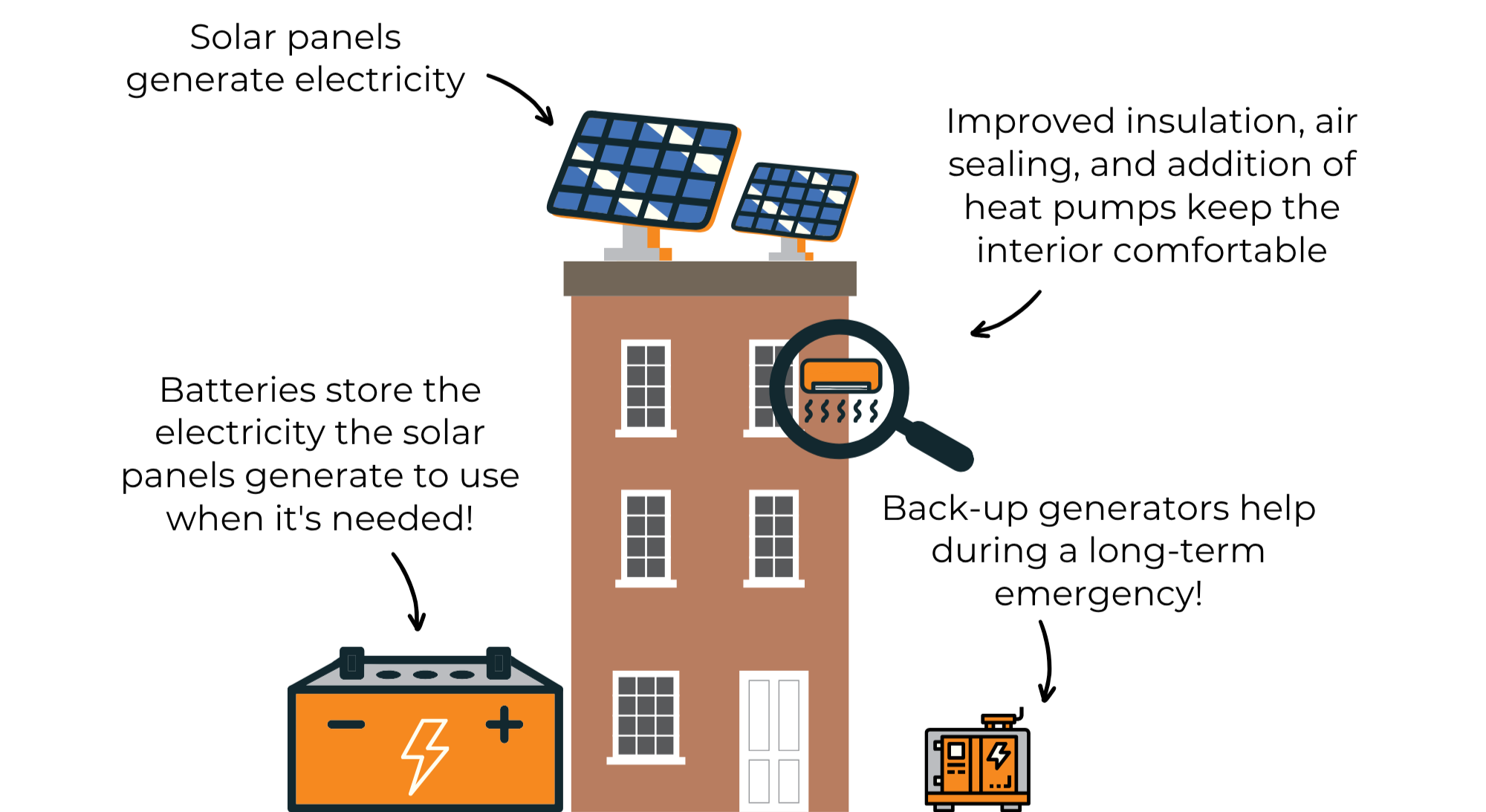
A system of solar panels connected to battery storage is our recommended centerpiece for backup power. This system is clean, quiet, and increasingly affordable, and it can run day-to-day operations even outside of emergencies. In certain geographies, it can also be a modest but impactful source of revenue. A generator is worth having as a backup to the backup—something to lean on if an outage runs long enough that stored battery power runs low. The right sizing depends on your budget, your building, and how long an outage you're realistically planning for. An engineer on your project team will assist with this, utilizing information from the feasibility assessment report.
In New England, we must plan for extreme cold and extreme heat. A hub that can keep people warm during a winter storm outage is doing just as much resilience work as one that offers cooling during a heat wave, and the equipment needs (insulation, heating capacity, safe backup heat sources) are worth planning for from the start rather than adding later. Heat pumps are therefore a great option; they are efficient and clean, and can be augmented by another heat source if truly needed.
We also encourage all buildings to implement energy efficiency solutions, such as improving insulation and air sealing throughout the building, before any other work is done. Energy efficiency measures can significantly reduce energy costs while maintaining a more comfortable interior. Electrical panel upgrades may be necessary to accommodate these building and power upgrades. Programs like Mass Save can help determine what needs to be done and offer financing options or support.
Beyond power, consider communications redundancy (can people reach the hub, and can the hub reach them, if cell networks are down?) and basic supply needs: water, medical supplies, food storage, depending on the services you've committed to offering. Where full-service hubs often add HVAC upgrades for heat and cold resilience (now, commonly, heat pumps), or backup water systems, an emerging hub might start with a single battery for phone charging and a stocked supply closet.
Transit and accessibility deserve a place in this section too, not just at the site-selection stage. Think through how people without a car will actually get to the hub during a disruption, whether the path from the street or a bus stop is walkable and lit, and whether the space itself works for people with mobility, vision, or hearing needs once they arrive. Backup power is only useful if people can physically get to it. In the same vein, establish a plan to check on and transport individuals and households that may struggle to reach the hub or stay informed during disruptions, if possible.
Whatever equipment you choose, plan for who maintains it and how often it's tested. Backup power that hasn't been run in months tends to let you down exactly when you need it most. A simple, regular check-in is enough to prevent that.
It's worth repeating why this section comes sixth, not first: hardware without a plan, without staffing, and without community trust in the space tends to sit unused. The technical readiness matters, of course, but it's the last piece, not the first.

Phase Seven: Launch & Operations
Launching a hub is more than simply opening the doors. Staff, volunteers, and any other key personnel must be ready to operate in all three modes. Build and practice an activation protocol: who makes the call, how the community is notified, and what the first hours look like. Regular drills, even simple ones, show you what needs fixing before an actual emergency does.
Ongoing communication matters just as much as the disruption-mode plan. If your community doesn't know the hub exists, or doesn't know what it offers, none of the planning that came before will pay off when it's needed. Weave hub awareness into the everyday programming that's already bringing people through the door.
Finally, plan for maintenance. Maintenance of equipment, of relationships, and of the governance structure itself. Staff and volunteers turn over; committees need renewal; batteries and generators need testing on a schedule, not just when something breaks.
A soft launch can be a useful step before a full public opening: invite your closest partners and a subset of residents to use the hub during its everyday mode first, gather feedback, and adjust before broader promotion. It's much easier to fix a scheduling conflict or an access issue with twenty people than after the whole neighborhood knows the doors are open.
Phase Eight: Sustaining & Growing
A resilience hub is an ongoing commitment that doesn’t end once it’s operational. Build in regular evaluation of what's working, what residents are actually using, and what needs to change, and revisit your funding plan as the hub matures rather than treating the initial grant as the finish line.
Some organizations eventually look to expand by adding services, supporting a second site, or helping neighboring communities replicate what they've built. That's a natural next chapter once the first hub is stable, but certainly not a requirement.
Sustaining a hub doesn't mean never changing its scale. Remember the continuum we mentioned at the building, offered by Collective Resilience? Some hubs may look to move along that continuum: An emerging hub might grow into a full-service one over several years, while a full-service hub might scale back certain services if community needs shift. The goal isn't to lock in a fixed model, but to keep checking that the hub still matches what your community actually needs. Other structures exist, as well. In some communities, like Somerville, there may not be a single community anchor or easily converted building. Instead, a group of organizations and sites can form a decentralized resilience network. Of course, there are trade-offs to consider. But for some communities, this might align best with their needs and capacity.
Wherever your organization lands on this path—just starting to assess readiness, deep into funding conversations, or ready to launch—Climable is glad to be a thought partner, and in some cases a project lead, for community groups doing this work. If that's useful to you, reach out and let's talk about what your community needs.
The following resources may prove helpful to organizations or coalitions at various stages of resilience hub development. Some will be more relevant than others. Climable does not own or control the majority of these resources, and we are not responsible for any of the content they contain. We vetted and endorsed these resources at the time of this page’s publication (and relied on many in the past).
Toolkits, guides, and resources:
Georgetown Climate Center: Supporting the Development of Resilience Hubs
CRC + ONE + Farr: Resilience Hub Planning and Design Compendium 2025 (check out the Continuum Illustrative Resilience Hub Options on slides 52 & 53)
Additional Resources & Acknowledgements
Community engagement and assessment resources (Phase 1):
Community Engagement 101: Ultimate Beginner’s Guide - Visible Networks Lab
Best Practices for Meaningful Community Engagement: Tips for Engaging Historically Underrepresented Populations in Visioning and Planning - Groundwork USA
Community Engagement Guide for Sustainable Communities - Policy Link
Authentic Community Engagement to Advance Equity - Colorado Department of Public Health & Environment
Neighborhoods at Risk - Headwaters Economics
Equity Resource Navigator - Urban Institute
MA Environmental Justice Viewer (Maps & Data) - Commonwealth of Massachusetts
Social Vulnerability Index - Agency for Toxic Substances and Disease Registry
Other helpful resources:
Building Community Partnership Governance Capacity: Strategies and Lessons from Best Start - First 5 Los Angeles
How to Make Your Community Space into a Hub for Local Resilience and Mutual Aid - Shareable
The Response: Disaster Collectivism and Community Resilience - Shareable
Neighborhood Pods How-To (Mutual Aid Guide) - Mutual Aid Medford And Somerville (MAMAS)
Climate Resilience as Disaster Collectivism - Climate Resilience Project
Transition Is Inevitable, Justice Is Not: A Critical Framework for Just Recovery - Movement Generation: Justice & Ecology Project
How a Microgrid Transformed a California Senior Center into a Resiliency Hub - Microgrid Knowledge
Climable would like to thank Baja and the Resilience Hub Collaborative team for their guidance and support. We strongly recommend the Resilience Hub Academy for any groups seeking to manage a resilience hub project on their own, or to become a project facilitator for other groups. Also instrumental to our understanding of resilience hubs and our success as project leads is the Urban Sustainability Directors Network. We would like to extend much gratitude to their team. The resources provided by Collective Resilience, the MAPC, the City of Austin, Georgia Interfaith Power and Light Company, and Shareable offered additional insights that filled in gaps and added color to this resources. Thank you to all involved in creating their resources.