
Resilience Hubs
Community-driven response to extreme weather events and other challenges facing environmental justice communities
Page Contents
What is a Resilience Hub?
A Resilience Hub is a local, community-driven facility that can support long-term community health and wellness. They address everyday needs such as social programming, food help, and legal resources.
Resilience Hubs also act as a first point of contact in the aftermath of an extreme weather event such as a flood, storm, power outage, or heatwave. Federal government organizations like FEMA (Federal Emergency Management Agency) or HUD (Department of Housing and Urban Development) can help affected communities through Disaster Recovery Centers (DRCs) to provide immediate resources to those suffering from a hazardous event. However, DRCs are often temporary and only provide help for a limited amount of time. DRCs need federal authorization to declare an emergency in an area before they can provide aid. By contrast, Resilience Hubs can mobilize people and other resources after the federal government has run out of funding because they add on to existing spaces.
Resilience Hubs work on the trust built through everyday connections and relationships to provide a central meeting space for all. Think of places that you trust in your neighborhood or community: is it your barber shop? The mom and pop grocery store? Church? Or a community center? These locations, run by people who live or spend considerable time in your neighborhood, can become Resilience Hubs.
Goals of Resilience Hubs
Equity & Environmental Justice
Community Care & Belonging
Disaster Preparedness
Climate Solutions
What is the history of Resilience Hubs?
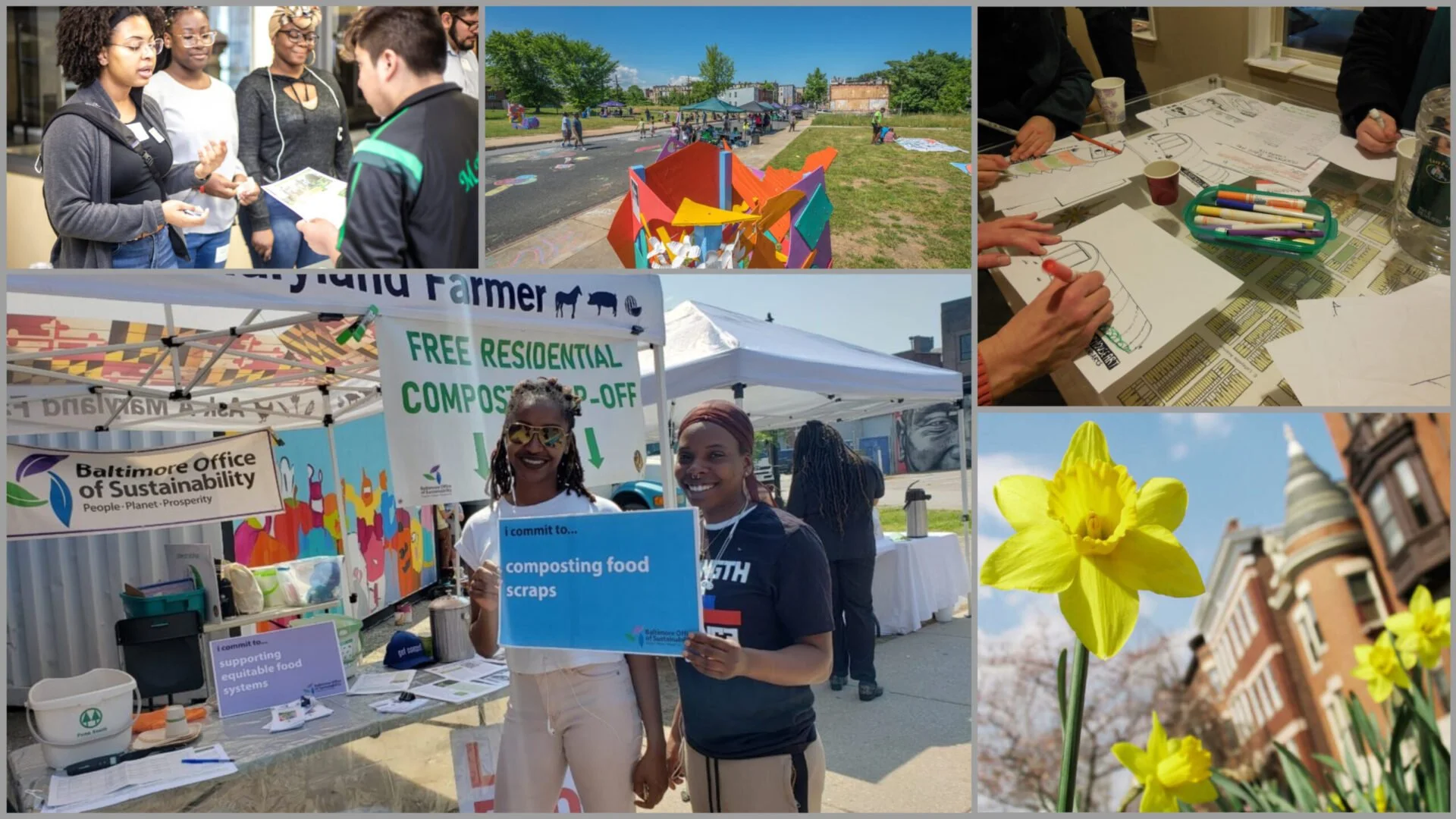
In 2012, Kristin “Baja” Baja and the Urban Sustainability Directors Network built one of the earliest examples of Resilience Hubs in Baltimore, MD. Baja and her team noticed that Baltimore residents were less likely to accept government help to prepare for climate emergencies. Especially those living in vulnerable communities. This was due to a history of corruption within the local Baltimore government and community mistrust of social welfare programs.

In addition, climate emergencies were not the only issues on Baltimore resident’s minds. They worried about everyday needs like childcare, job support, and food assistance. Baja conceived of Resilience Hubs as an alternative to government assistance, offering a third space managed by people and organizations the community trusts rather than government staff. Resilience Hubs go beyond being a single point of contact during emergencies; they are a place where people can get their basic needs met.
ADvantages of Resilience Hubs
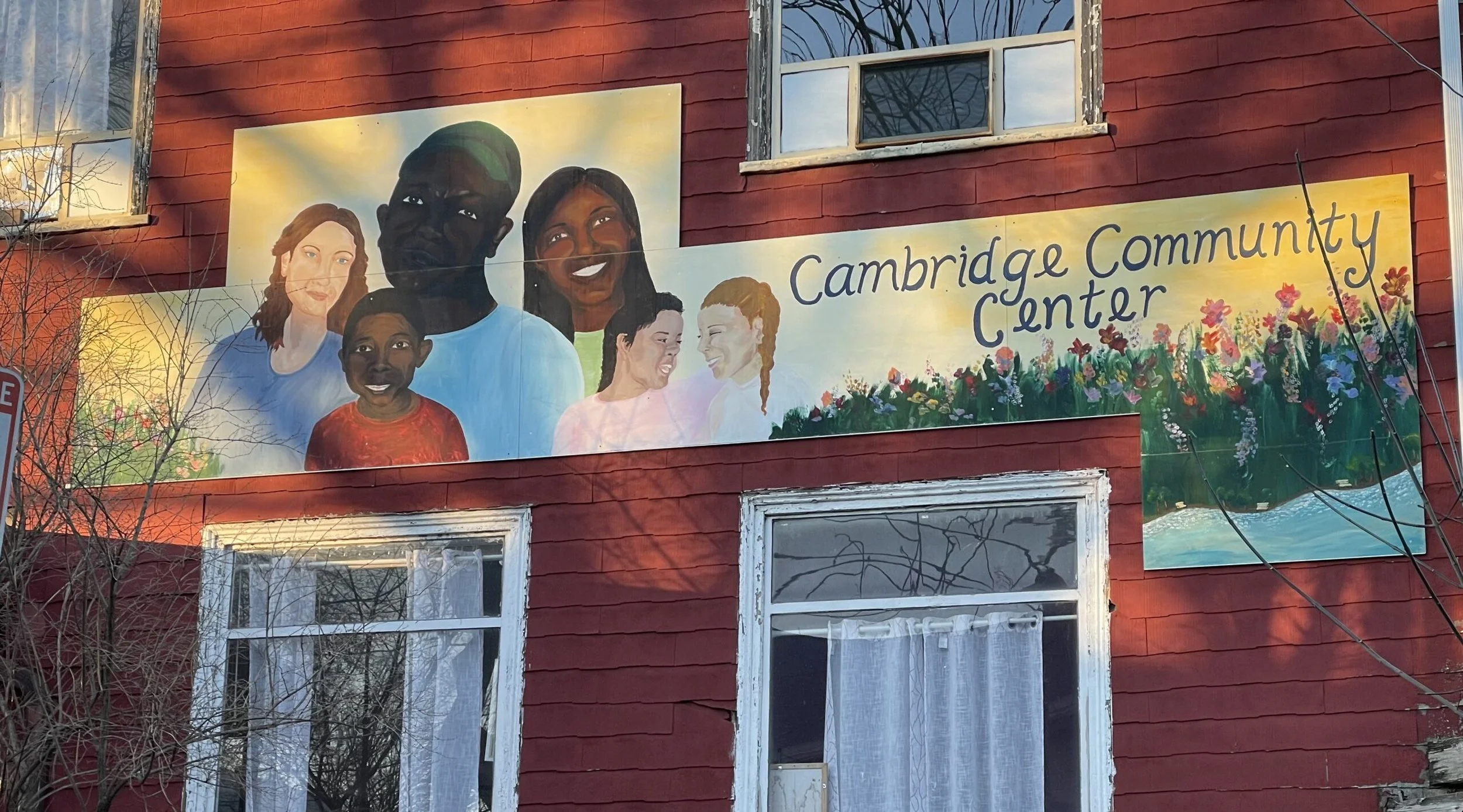
The great thing about Resilience Hubs is that there is no “one size fits all.” Resilience Hubs can be whatever communities need them to be. Some, like those run by CREW (Communities Responding to Extreme Weather), are flexible locations that serve as emergency shelters during extreme weather events. They display brochures about resources that community members might need throughout the year.
Other Resilience Hubs, like those developed by the Resilient Mystic Collaborative (RMC), range from cooling centers to combat heatwaves to social programming like film screenings and tree plantings. RMC engages people about the effects of climate change and hazardous weather events.
Resilience Hubs can be as big and expansive or as small and focused as communities need them to be. Other factors that determine Resilience Hub size can be funding, available space, or the number of volunteers. They are not meant to be an extra strain on community resources, but rather work alongside them to prepare everyone for life’s everyday challenges. No matter their size nor services offered, Resilience Hubs strengthen communities because they are designed by the community.

Modes of Operation
Normal Mode
“Blue sky days”
Regular, day-to-day operation protocols.
Disruption Mode
“Grey sky days”
Emergency operation protocols activated
Recovery Mode
“Building anew”
Post-emergency operation protocols.
As covered above, Resilience Hubs are intended to provide programs, services, and safe space throughout nearly any condition or circumstance. In the technical parlance, Hubs should be prepared to operate in three “modes,” each of which covers different circumstances.
Normal Mode (or Steady State)
As the name suggests, this is the everyday mode. There are no major, community-wide disruptions to daily life present. A Hub will operate in this mode the vast majority of the time. Daily stressors are the highest priority, and all infrastructure and services are available. In normal mode, the primary focus is on community services, programming, and relationship-building. This is also the time to prepare, train, and practice responses for different disruptions or crisis scenarios.
Disruption Mode
A hub enters this mode when there is a disruption to everyday function or site use, typically at a community scale or greater, lasting for any duration. Disruptions can be any type of disaster or emergency, from major storms and extreme weather to public health emergencies, mass shootings, and economic crises. When a hub enters disruption mode, emergency operation protocols are activated. The nature of the disruption will dictate the specifics of the emergency protocols. For example, the response to a wave of extreme heat or prolonged blackout will be quite different from the response to a pandemic or other public health emergency. Disruption Mode plans should also outline protocols for evacuation-order scenarios.
Recovery Mode
Recovery is often overlooked but is just as critical as the other modes. Recovery Mode protocols are the process for recovering from a disruption and finding the new normal. Indeed, Recovery is not intended to return a hub or the community to the status quo before the disruption. The intention, rather, is to acknowledge that the baseline has changed. These protocols help the community learn and grow as they build around this new baseline. Think: all the changes that stuck and became part of the new normal after the Covid lockdowns.
Resilience Hub Components and Modes
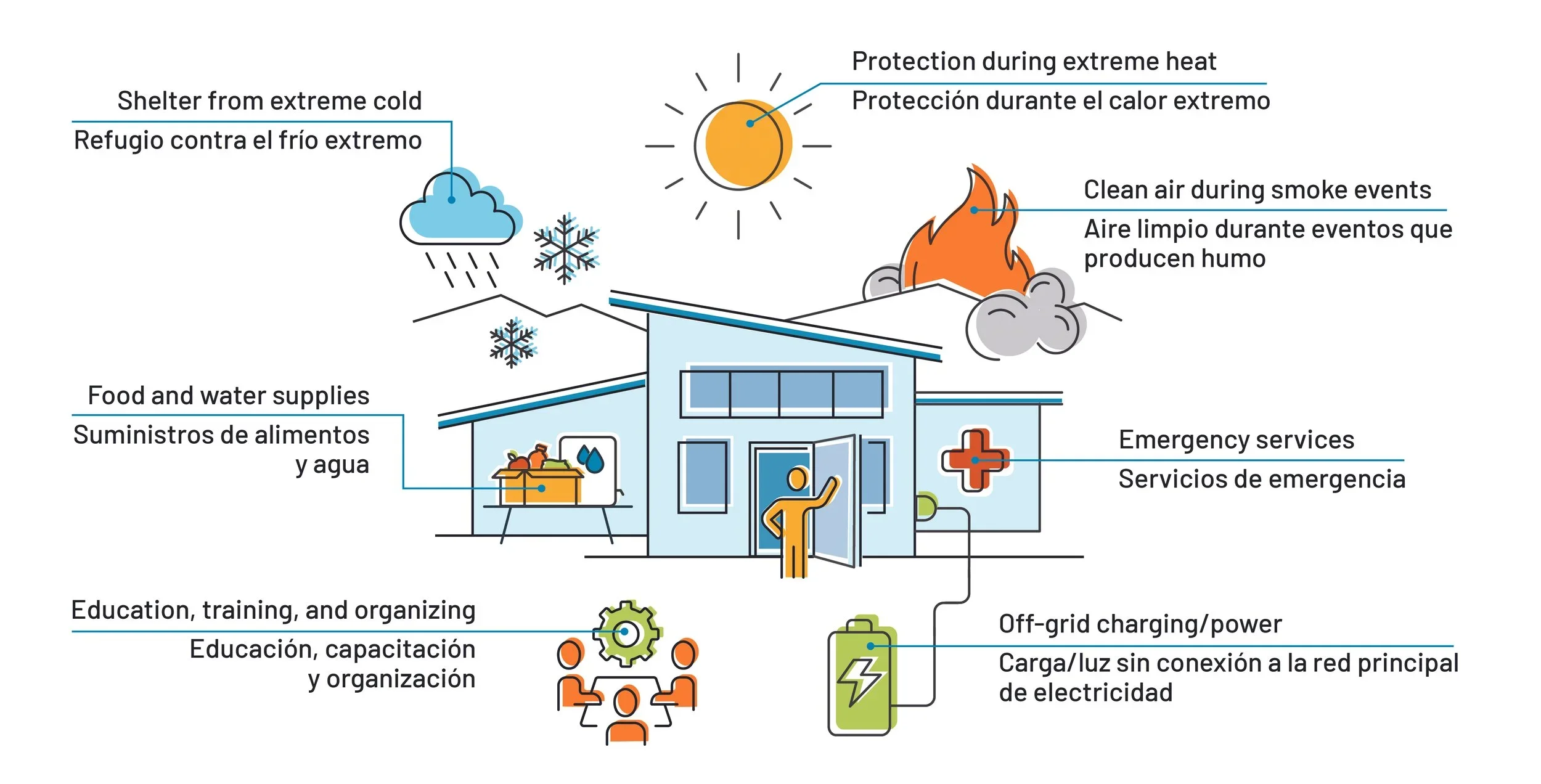
The most effective hubs are co-designed and co-lead by residents and local organizations. So, Resilience Hubs can look different and offer different services, determined by community needs, priorities, and resource availability (in particular, funding availability and operational capacity). But there are ideal core components for which Resilience Hubs can strive, and when possible, Hubs should operate across three modes of operation: Normal/Everyday, Disruption, and Recovery. Continue reading for more details.
Resilience Hub Components
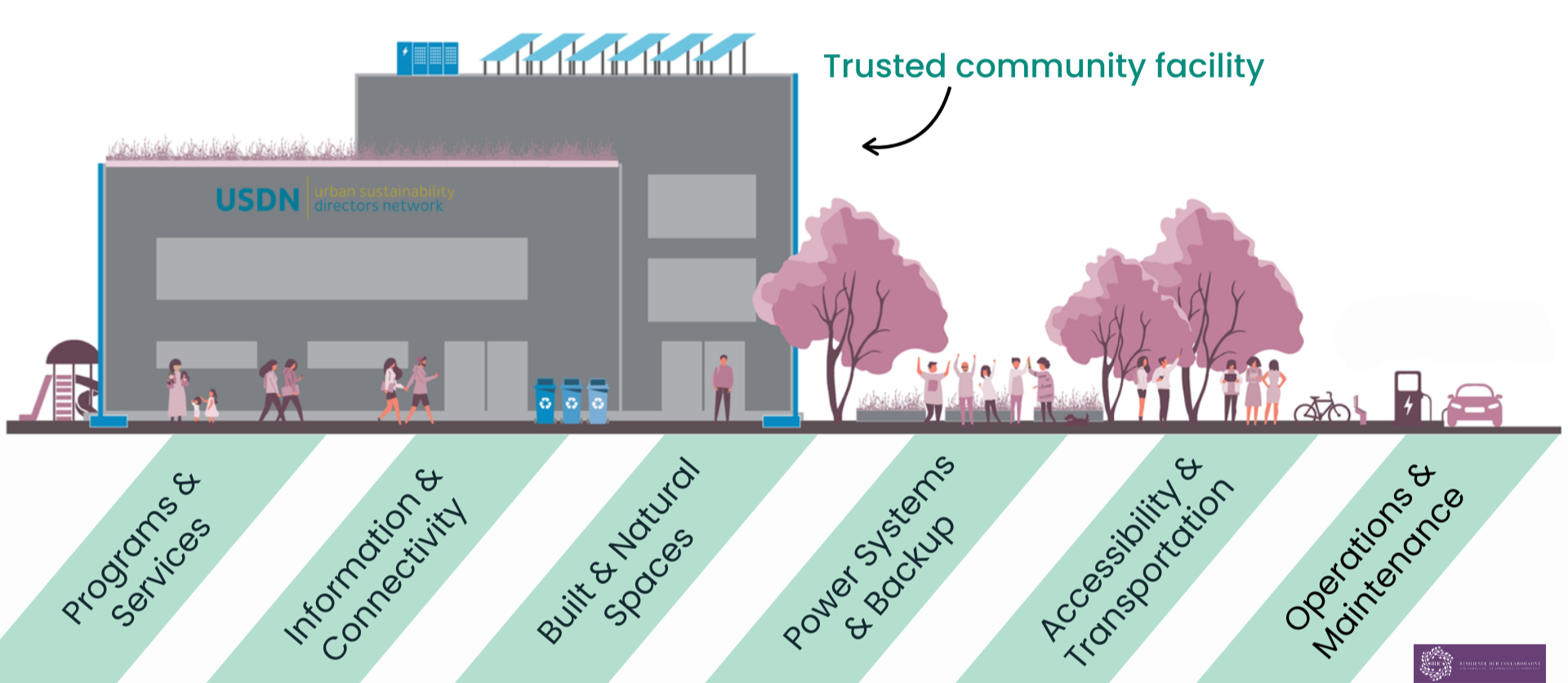
Graphic by Climable, 2026. Facility illustration by USDN & Kristin Baja, undated.
1.
Programs & Services
This is the most important component of a Resilience Hub. Yet, too often, it gets overlooked or undervalued during the design and development process. So, let’s say it again:
This is the most important component!
Programs and services are the heart of a Resilience Hub. They build social cohesion and social capital by meeting community members’ most pressing needs and providing a third space to connect with neighbors. Ideally, services are geared toward harm reduction for residents from marginalized populations. Through community-specific offerings, they can promote health, wellness, and stability.
Programs and services may include disaster preparedness workshops, cooling/warming center capabilities, and community gardening. Higher capacity hubs may offer cultural programming, community classes, childcare, workforce development, and social services support. Resilience Hubs also make great locations for mutual aid and food distribution.
Information & Connectivity
The essence of a resilience hub can be found, in a large part, in the sense of belonging they provide for daily users. This is what makes them more than an emergency shelter. It’s also why community leadership is essential and why regularly offered programs and services are valuable.
Communities that thrive in the face of disaster are ones with strong bonds and networks. Without it, a resilience hub will be less effective and, at worst, unused. It is therefore essential to provide opportunities for community members to spend quality time at the site during normal times, building relationships with the folks running it as well as those using it.
Hub operators will also need to determine emergency communication protocols with the appropriate emergency responders, local officials and community leaders, and the surrounding network of community support.
2.
3.
Built & Natural Spaces
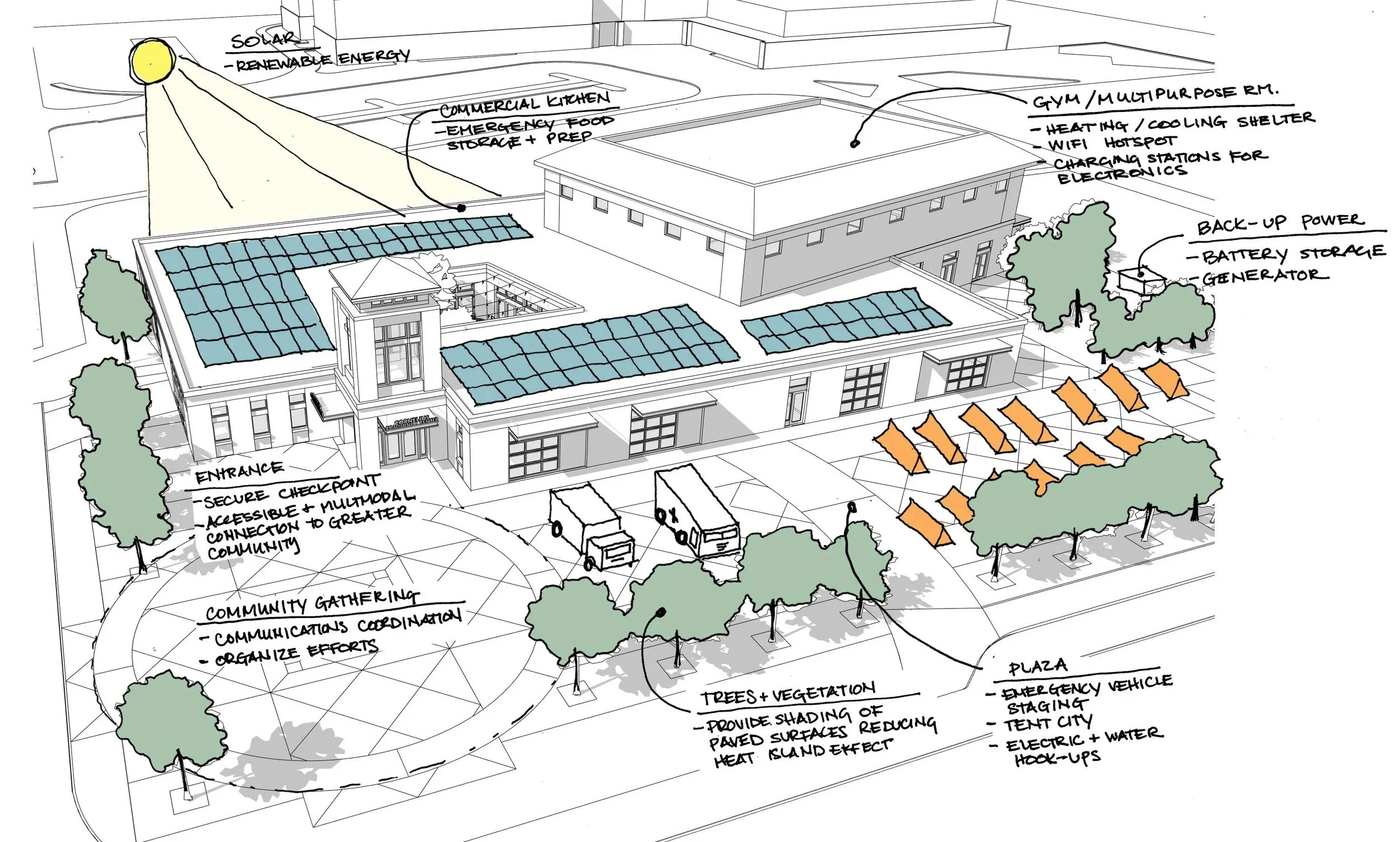
A resilience hub’s built and natural spaces should reinforce that same sense of belonging. Flexible, comfortable interiors—such as movable furniture, a working kitchen, reliable Wi-Fi—make the space functional for a potluck as easily as a cooling center, so daily use and emergency use feel like the same building, not two different ones. Familiarity doesn’t end with the people, users must know and trust the facility as well.
Natural spaces do similar work outdoors. A garden, some shade trees, or a few planting beds give neighbors a reason to linger and get to know each other, while also offering real value: shade during heat waves, and permeable landscaping to help manage stormwater during heavy rain.
Accessible pathways, clear sight-lines, and a welcoming, accessible entrance matter just as much on an ordinary Saturday as during a blackout. A grandparent, a wheelchair user, or a parent with a stroller must be able to move through the site with ease, whatever mode the hub is in.
4.
Power Systems & Backup
Resilient power systems what will perhaps make or break a resilience hub during a power outage. Solar paired with battery storage should be the centerpiece of a hub's backup power system: it runs quietly, needs no fuel deliveries during a crisis, and can keep serving the building day to day, offsetting energy costs even when nothing is wrong. A generator can be leaned on if an outage runs long enough to draw down the battery, but it won’t need to be the first thing to switch on.
What the system actually needs to power matters as much as its size. A hub doesn't need to run everything; it needs to keep the essentials going — lighting, communications, refrigeration for medication and food, and a few outlets for charging phones and medical devices. Sizing the system around those priorities, rather than the whole building, keeps costs manageable and keeps the hub genuinely useful during a multi-day outage.
During normal and recovery modes, the battery and solar panels can offer cost-savings on the electricity bill, giving the hub a bit more breathing room on finances while also improving the local grid’s resilience and reducing reliance on fossil fuels.
5.
Accessibility & Transportation
This component can be overlooked or not thought of as early as it should be. Accessibility and transportation considerations are essential! A hub that people can't reach or move through isn't much of a hub. Transit access should be part of the site selection conversation from the start; a location near a bus line, subway stop, or within walking distance of the neighborhoods it's meant to serve will see far more daily use, and far more people able to reach it in an emergency, than one that assumes everyone arrives by car.
Inside and around the building, accessibility should hold up under both normal and emergency conditions. Ramps, wide doorways, accessible restrooms, and clear, well-lit pathways matter every day, but they matter even more during a disruption, when people may be moving through the space while injured, exhausted, or relying on mobility aids they don't usually use. Backup power should extend to accessibility features too—an accessible entrance is only accessible if its automatic door still works when the grid doesn't. This extends to the outdoor spaces as well. Gardening, shade, and recreation areas should be as accessible as they can be.
6.
Operations & Maintenance
Last but not least, consider the running and upkeep. A hub is only as resilient as the systems that keep it running day to day. Regular maintenance of solar panels, batteries, water and refrigeration systems, and backup equipment shouldn't wait for an emergency to reveal a problem. A simple, scheduled check-in routine, with clear ownership of who's responsible for what, keeps the hub ready without demanding constant attention. Equipment might require more than one frequency of check-in (e.g., a water system might need weekly or monthly water quality tests and yearly servicing) and different licensed professionals might be required, so ensuring budget is planned and set aside for maintenance is key.
Staffing follows the same logic as everything else in a resilience hub: the people who run it day to day should be the same people (or at least familiar faces) who show up during a disruption. That continuity is what lets a hub shift smoothly between its normal, disruption, and recovery modes, since operators already know the space, the equipment, and the community members who'll be relying on it. Bringing in community volunteers is great. But consider the risk in reliability that might introduce. Paying folks, even if they are simply on-call during emergencies, can ensure the right people are where they need to be during a disruption.
Finally, it is critical that all protocols, plans, and practices are documented for all three modes so as much institutional knowledge is preserved within the hub as possible. A resilience hub’s reliability and efficiency can be significantly impacted if a knowledge-gap opens up for any reason. Strong records can save money and lives.
Additional Resources
Interested in setting up a Resilience Hub but don’t know where to start?
Check out our guide to getting start here.
Or contact Climable if you want to learn more about establishing a Resilience Hub near you.
-
Dorchester Food Co-op (Dorchester, MA)
Boyle Heights Arts Conservatory (Los Angeles, CA)
-
Cover image and webpage thumbnail courtesy of Just Imagine SWLA and Scott Edwards Architecture