
Making E-Bikes Accessible: Why Mass’s E-Bike Incentive Programs matter
by Uma Zierten-Singleton
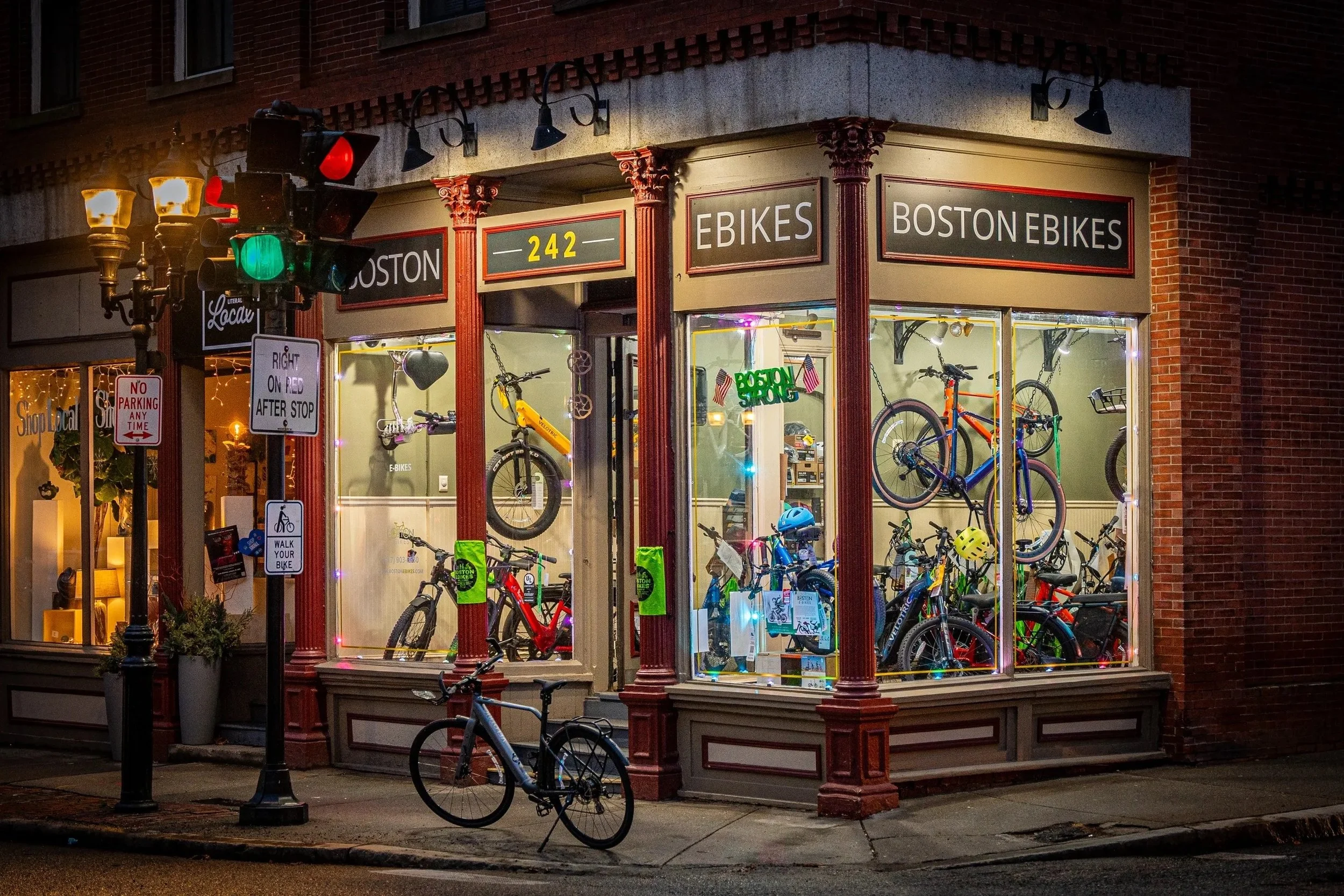
“Boston eBikes” storefront in Brookline, MA
As gasoline prices continue to rise and concerns about vehicle emissions and their environmental impacts grow in a similar fashion, people have begun to look toward electrification as a long-term solution. And not just electric vehicles, but bicycles as well. However, just like EVs, adoption of e-bikes has a major barrier to entry for many commuters: the cost. That's why Massachusetts' e-bike incentive programs are worth investing in, and why they shouldn't be treated as temporary programs that disappear when the funding runs out.
This is where Massachusetts' e-bike incentive programs come in. In April 2025, the Massachusetts Clean Energy Center (MassCEC) launched a Statewide Electric Bike Incentive Program, offering income-based vouchers to help low- and moderate-income residents across the state afford an e-bike. Several cities and regional agencies run their own versions alongside it. Boston's E-Bikes Incentive Program is funded by the American Rescue Plan Act or ARPA, and provides vouchers starting at $800 to Boston residents purchasing a standard, cargo, or adaptive e-bike.
Besides reducing emissions overall, access to e-bikes for these communities in particular can mean money saved on fuel or vehicle maintenance, providing a means of transportation that wasn't accessible before, or improving mobility options. Furthermore, to charge a 300-watt-hour e-bike battery, it costs only about 11 cents (MassCEC's estimate, based on 30 cents per kilowatt-hour and 80% charging efficiency), meaning that battery charging doesn't impose a large burden on consumers' electric bills. And finally, e-biking provides exercise and mental health benefits, while also allowing riders to carry children, cargo, or groceries in a manageable way.
Who Can Get a Voucher?
Who can get a voucher, and how much is it worth? Eligibility and amounts vary by program. Boston's program targets three specific groups: income-eligible residents at or below 40% of area median income, adults 60 and older, and adults with disabilities. Vouchers run from $800 to $1,200 for standard e-bikes, $1,100 to $1,500 for cargo e-bikes, and from $2,000 to $5,000 for adaptive e-bikes, plus a $150 safety equipment voucher for everyone. Standard and cargo e-bikes must be purchased new through participating bike shops, and the battery must supply 750 watts of power or less. Vouchers remain valid for 45 days after they're issued.
These programs are especially important when it comes to transportation equity. The people who could benefit most from an e-bike aren't necessarily the people who can afford one. For someone who already has a reliable car, an e-bike might just be another transportation option. But for someone who doesn't have a car, has a long commute, lives somewhere with limited public transportation, or needs to carry groceries or children, an e-bike can make a much bigger difference. The voucher isn't just making a bike cheaper; it's making another form of transportation available to people who might not otherwise have access to it.
The Safety Concerns
There are also some legitimate concerns that come with e-bikes, and it's worth acknowledging them. E-bike batteries are usually lithium-ion batteries, which can catch fire if they are damaged, improperly charged, or stored incorrectly. Where people charge and store their e-bikes matters, especially in apartments or other places where a battery fire could put more people at risk.
E-bikes can also travel much faster than traditional bicycles, which means riders have to adjust to different speeds and reaction times, and drivers and pedestrians have to do the same. These aren't reasons to stop funding e-bike programs, but they are reasons to make safety education and safe charging part of the programs themselves.
The Uncertain Future of E-Bike Incentives
As for the future of these programs, the picture is mixed and, in most cases, uncertain. MassCEC's statewide voucher program is currently closed, and the agency has said on its site that it is not expected to run in 2026. The statewide program was designed as a pilot, so its end was not necessarily unexpected. But that raises a bigger question: if the point of a pilot is to see whether something works, what happens when it does?
Boston's program is a bright spot at the moment: it reopened its general application from July 20 to August 3, 2026, the same pilot that has issued 1,167 vouchers to date. But Boston is also candid about the risk: it is grant-funded, and the city states plainly that there are no application rounds planned for the next year, pending a change in funding.
The program's reliance on ARPA funding is especially important because those federal funds have a deadline. Boston says its ARPA funds must be fully spent by December 31, 2026, meaning that money cannot be used as a permanent source of funding for the program.
So this isn't really a benefit anyone can count on. It's a set of pilot programs that open, close, and might not open again. If you're eligible and a window happens to be open, the honest advice is to apply now rather than assume there'll be another chance.
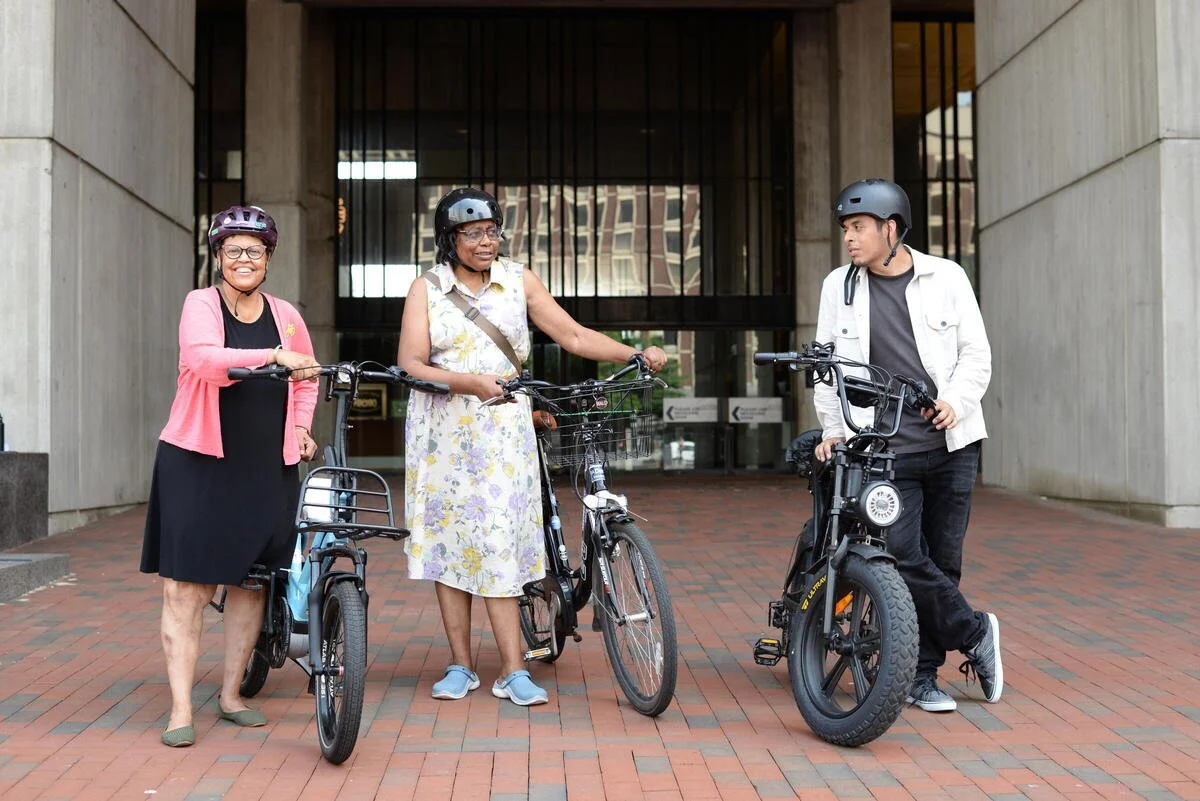
A photo of Boston e-bike incentive program voucher recipients via boston.gov
That's Not Good Enough
Access to affordable transportation shouldn't depend on catching a two-week application window before a grant runs dry. If these programs actually work–and the numbers suggest they do–they deserve permanent, dedicated funding instead of getting stitched back together year to year with whatever federal relief dollars happen to still be around. MassCEC says that the success of its earlier e-bike pilots informed the statewide voucher program, and the statewide program ultimately provided thousands of residents with access to e-bike vouchers. MassCEC's overview of the e-bike programs makes clear that these programs have already been used to test and expand access to e-bikes.
A state that's serious about getting people out of cars needs to treat e-bike access the same way it treats other transportation infrastructure: as an ongoing effort.
Massachusetts has already started testing these programs. Now it needs to take the next step. Instead of waiting for another grant, the state should create permanent funding for e-bike incentives and make safety education part of the process. Cities should also look for ways to build e-bike incentives into their transportation budgets rather than relying entirely on temporary federal funding. Boston's current program is still operating, but the city's program materials show that it remains a pilot initiative rather than a permanent transportation benefit.
What Can We Do?
If you are eligible for a current e-bike incentive program, apply while the window is open. Boston's E-Bikes Incentive Program is currently the clearest example, although its most recent general application window ran from July 20 through August 3, 2026.
But there is also a bigger role for residents to play: tell your city councilors, state representatives, and other local officials that these programs are worth continuing. If e-bike incentives are helping people afford transportation, save money, and replace some car trips, that is exactly the kind of program that should be expanded, not allowed to disappear.
E-bikes aren't a perfect solution, and they don't need to be. But if Massachusetts wants cleaner transportation, fewer car trips, and more equitable mobility, it needs to make affordable e-bike access a permanent part of the system–not a temporary experiment that ends when the funding does.