
Data Centers as Public/Private Infrastructure
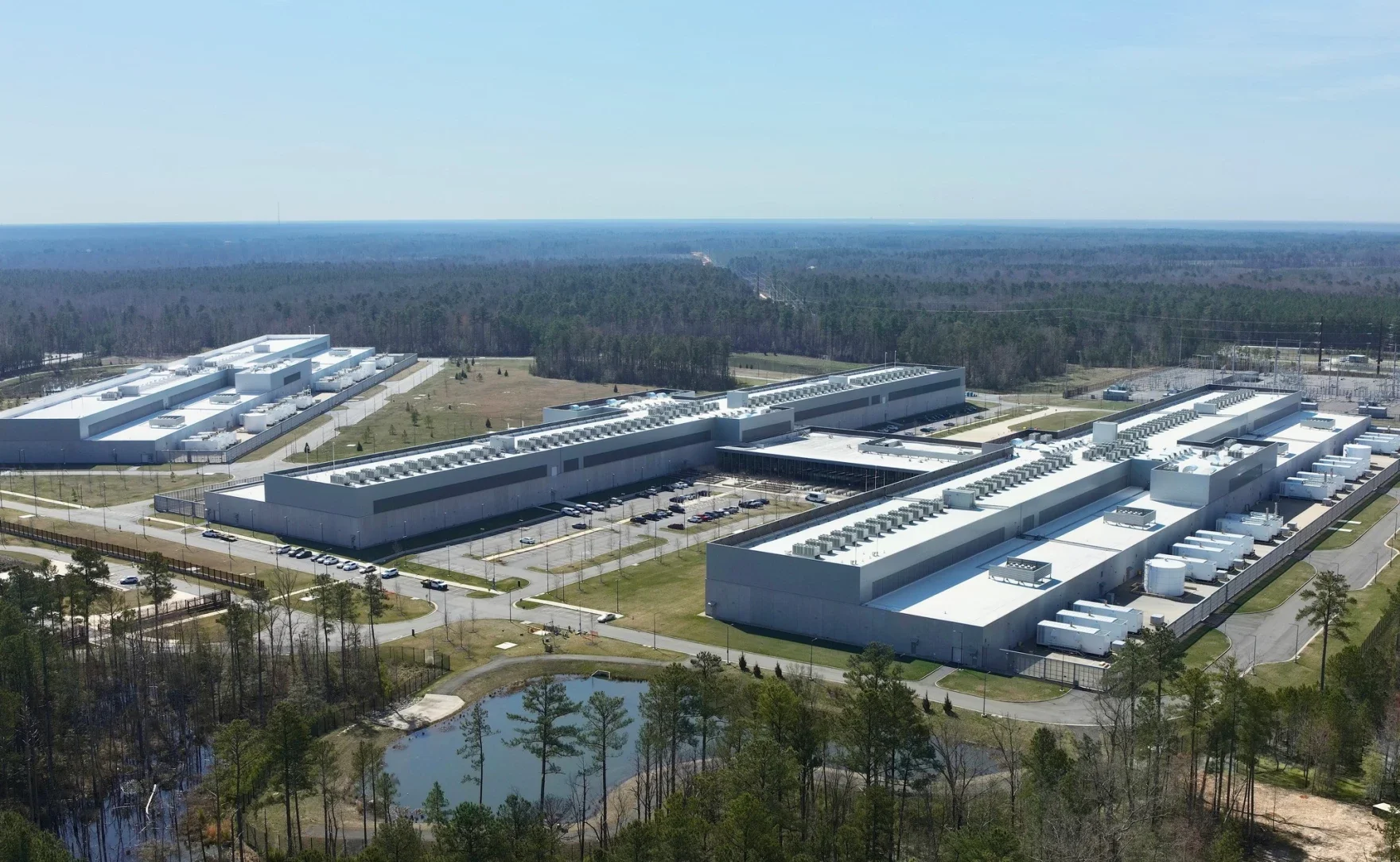
Meta's Henrico Data Center in Virgina. Image: WHRO Public Media, 2024
by Javier Zarazua
Did you know that Loudoun County, VA, is known as the “Data Center Capital of the World”? But what exactly is a data center, and why are they so relevant?
After the introduction of space-saving microcomputers in the 1990s, data centers evolved into large facilities designed to house physical Information Technology (IT) infrastructure. They contain computer servers, power systems, environmental controls, and network devices that enable companies to host software applications, such as Google Drive, maintain digital services, such as banking apps, and store client data, such as Instagram profiles. The concentrated design of data centers allows Cloud Service Providers (CSPs), like Amazon Web Services (AWS), to quickly scale operations as demand continues to grow. Since 2020, AWS’s investment in data infrastructure has increased their client capacity by 357%. This enables millions of people worldwide who use data centers to access digital services, including video streaming, chatbot prompting, image sharing, social networking, and more. As a result, an enormous amount of social, political, and economic life pumps through data centers.
What about the cost to the public and the environment?
In 2023, data centers in Northern Virginia, also known as “Data Center Alley,” consumed nearly 900,000,000 gallons of water for cooling. For reference, this is what 1,000,000 gallons of water looks like:
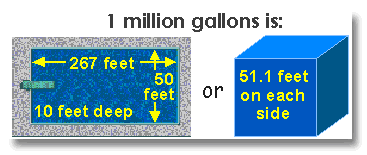
“Some Ways to Visualize a Million Gallons of Water.” Credit: USGS, 2022.
Description: A graphic with text at the top reading, “1 million gallons is,” and below are two blocks side by side. On the left, a blue 2D rectangle is shown with arrows and text indicating the long side is 267 feet, the short side is 50 feet, and the depth, which is not visualized, is 10 feet. On the right, a blue cube is shown with text indicating that each side is 51.1 feet.
If you were to line up nine hundred 267 feet wide swimming pools end to end, the resulting river would span over 45 miles. They also consume enormous amounts of physical space. Each data center can range from a few thousand square feet to over 10,000 or even millions of square feet (hyperscale). Data centers for AWS and other CSPs take up over 30,000,000 square feet in Northern Virginia alone. These facilities encroach on people’s homes, schools, and community centers, creating stressful environments.
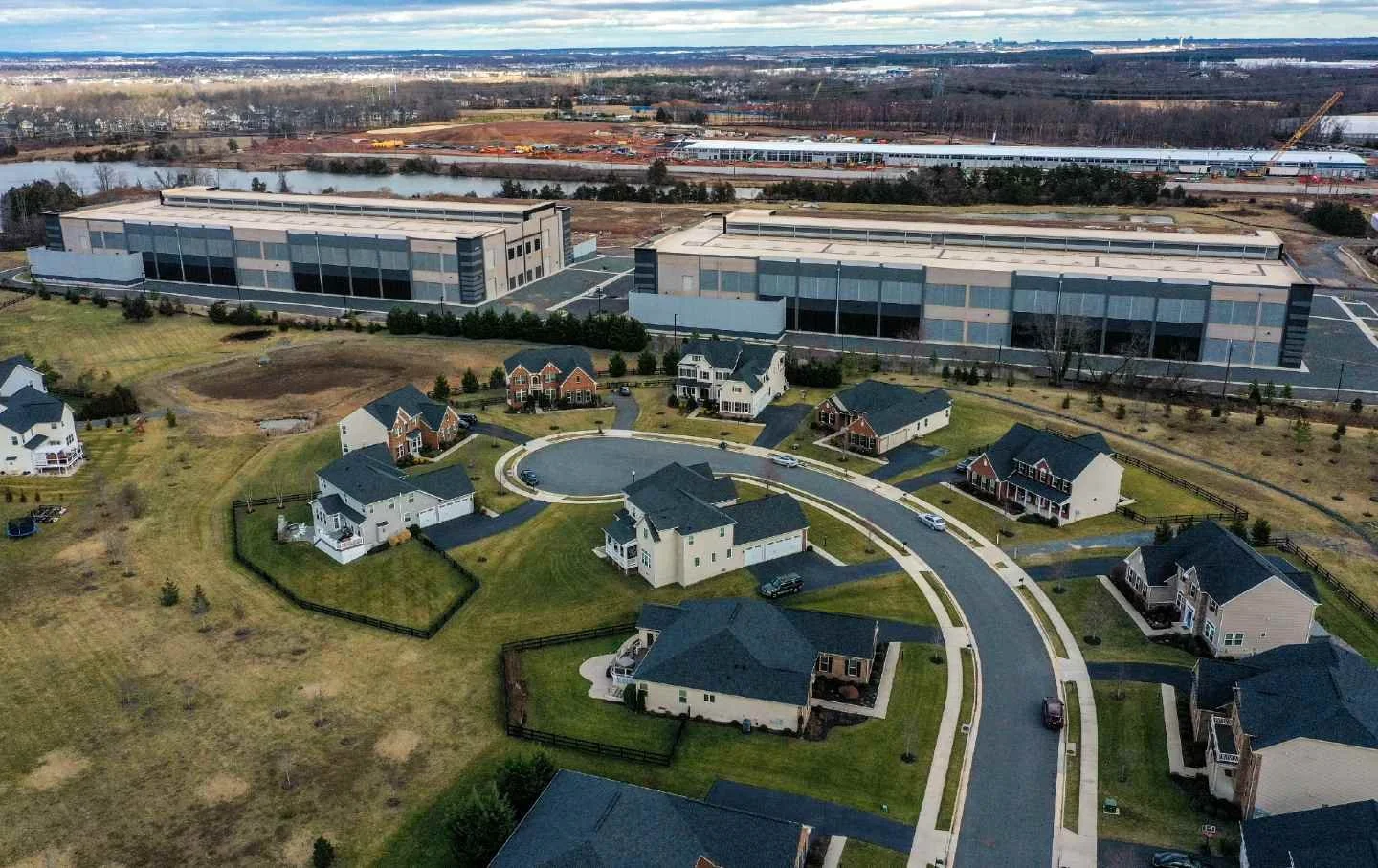
Amazon data centers loom over single-family houses at the end of a cul-de-sac in a suburban neighborhood on the edge of Loudoun County. Microsoft is in the process of building data-center structures across a river in the background, top right.
Photo credit: Jahi Chikwendiu / The Washington Post via Getty Images, January 20, 2023
The energy consumption for hyperscale data centers is also extremely high, exceeding 100 megawatt (MW) per year. According to Rice University, 1 MW is enough to potentially power 670 homes. So, the energy use of one hyperscale data center could power 67,000 homes in the U.S.—nearly half the number of homes in Loudoun County—for a year. “Goldman Sachs Research estimates that data center power demand will grow 160% by 2030.” For perspective, Northern Virginia is home to over 300 data center facilities, with 200 facilities in Loudoun County alone.
What does this mean for the people living there today?
It means increased air pollution, noise pollution, and strains on municipal power systems, which are currently reliant on fossil fuels to keep up with increasing data center power demand. This is completely destabilizing the region’s carbon emission targets. Public goods such as access to clean air, water, and networked energy are at risk for the sake of data infrastructure that fuels private capital gain. Loudoun County has not gone a single day without data center construction in the last 14 years—and the need for data centers shows no signs of stopping.
How can we reimagine data centers in Loudoun County and beyond?