Microgrids
What is a Microgrid?
A microgrid is a small-scale energy system that produces and stores electricity “onsite” or in close proximity to the buildings it serves. It can operate independently or in coordination with the larger power grid system. For example, military bases and some university campuses generate, store, and use their own energy instead of relying on the central grid. Others may use their microgrid as a backup electricity source during a power outages.
Microgrids can be a powerful solution for communities. Climable’s model uses them to provide backup power and cost-savings for environmental justice communities. We aim to strengthen community resilience by ensuring critical sites and services are functional during emergencies and establishing local energy democracy.
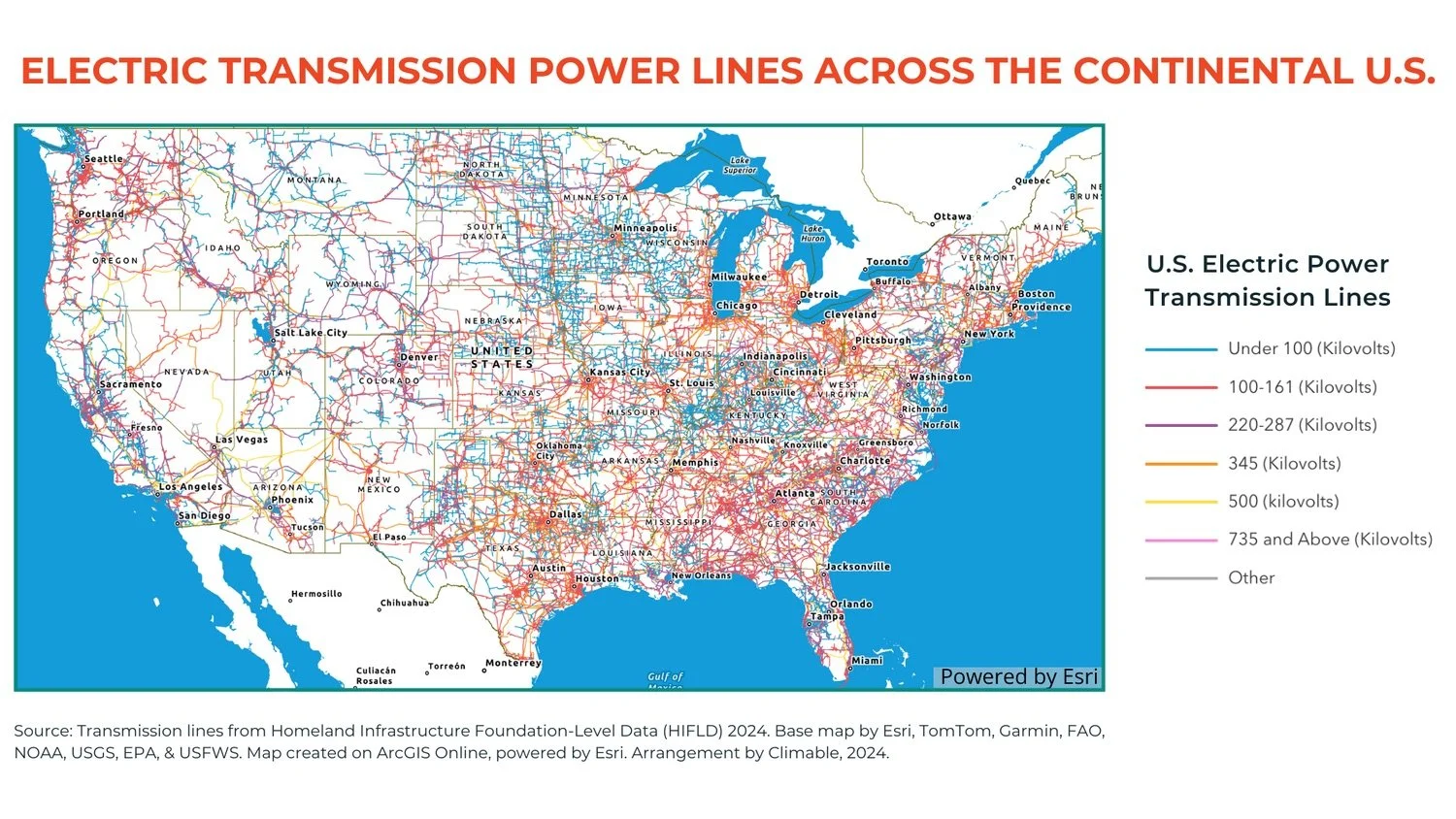
Contrast the main grid, which covers the entire US, with a microgrid, which is sized for a neighborhood, a block, or even just an individual building.
The above map shows the network of transmission lines in the continental United States, which are the thick power lines on the tall metal towers. Smaller distribution lines that connect directly to homes and buildings are not shown. They would fill in much of the white space between the transmission lines. Click the image to explore the interactive map on ArcGIS Online. Graphic: Climable, 2024
“Macro” Grid
To help understand a microgrid, it helps to think about the “macro” grid. This is the network of power plants, power lines, substations, and other equipment that bring electricity to homes, businesses, and industrial sites. It is more commonly referred to as “the grid” or the “main grid.” The layout of the grid is such that most power plants generate electricity in a centralized location and then sent to far away end-users. Indeed, it is often carried across hundreds of miles of transmission and distribution wires before reaching its final destination.
“Macro” Grid vs “Micro” Grid
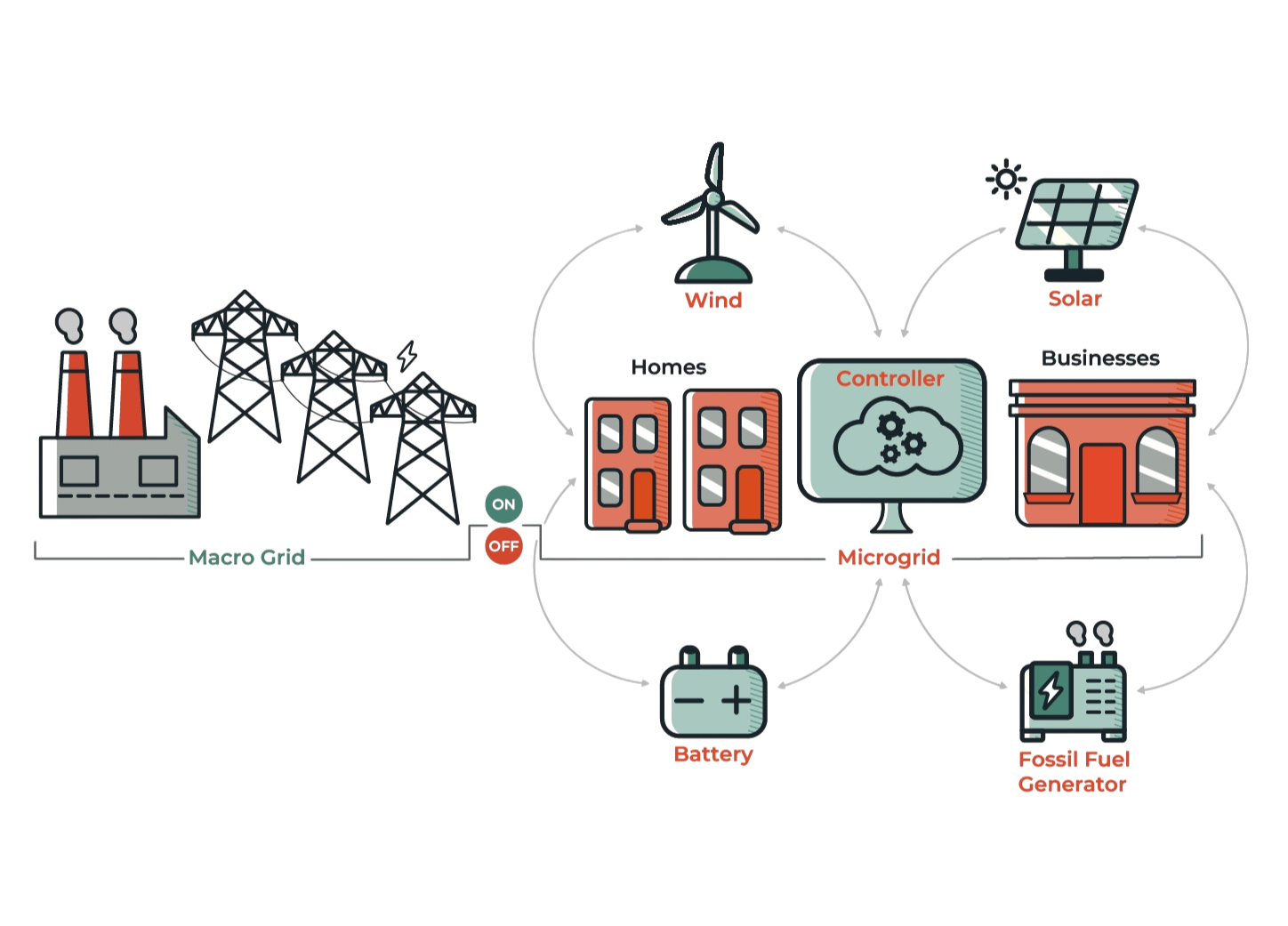
A simplified visualization of a microgrid. The macro grid is shown on the left, and the different microgrid components and participating buildings are on the right. The point of interconnection between the macro grid and the microgrid is displayed as an on/off switch, representing the microgrid’s ability to switch between grid-connected and island mode. The controller in the center of the microgrid coordinates this switch and the use of the different microgrid components. Graphic: Rachel Liang for Climable, 2024
“Micro” Grid
Like the main grid, a microgrid can also power homes, businesses, and industrial sites, but on a much smaller scale, as the name suggests. Like the main grid, they include power generation sources. However, they are built to serve a far more limited geographical footprint, serving only a handful of buildings, at most. Thus, their electricity generation capabilities are more limited. They generate electricity locally, often on or near the site of the buildings they power, rather than far away.
Core Components of a Microgrid
Local generation: Electricity for a microgrid system can come from multiple sources and be powered by fossil fuels, renewables, or a combination of both. Electricity sources are located very near the buildings they power.
Local Service: Microgrids only serve a specific area or a limited set of buildings that are physically close together.
Energy Storage: Many microgrids include battery storage. Batteries store energy from the local generation source for use to power buildings as needed.
Island Mode: Microgrids can connect and disconnect from the grid. If there is a grid disruption or power outage, microgrids can disconnect from the grid and power the connected buildings. This is known as “island mode” or “islanding”.
Climable’s Microgrid Model
Motivations and designs underpinning microgrids can differ. Climable values microgrids as a means to improve resilience, self-determination, and energy security in a community. They can be particularly beneficial for environmental justice communities. Environmental justice (EJ) communities are marginalized communities that face disproportionate environmental burdens and experience more frequent and intense heat waves, floods, and other adverse climate change impacts. On average, EJ communities experience more frequent grid disruptions and outages than wealthier, whiter communities. When developing microgrids, we prioritize any sites that are identified by the community as critical, which often includes community centers, emergency shelters, health clinics, food distribution sites or grocery stores, and emergency responders.
The model our microgrid designs follow is community-centered, to best embody the values and motivations outlined above.
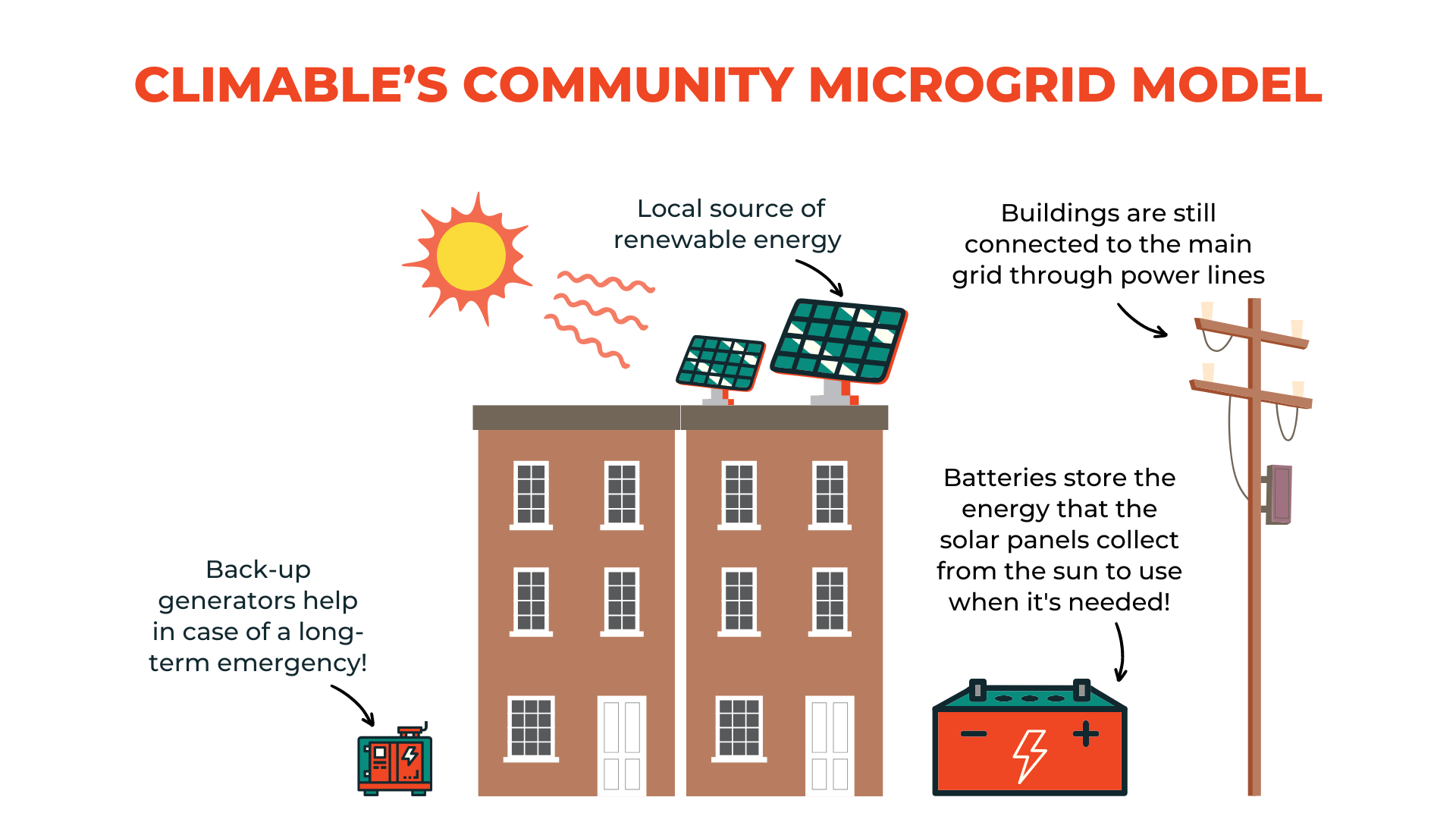
A visual example of Climable’s microgrid model applied to buildings in a neighborhood. During a grid outage, the buildings could draw power from the solar panels, battery, and backup generator; they can also switch into island mode during periods of high electricity demand to save money. Graphic: Rachel Liang | Climable, 2024.
Pillars of Climable’s Microgrid Model
Community-Led: Communities always come first in our projects. We work alongside community organizations to educate and engage community members throughout the microgrid project. Community representatives make key decisions about the design and operation. Climable then works to ensure that the community owns and controls the solar panels and batteries once installed.
Clean Powered: Solar panels and batteries provide the local electricity source, and we’re increasingly including bio-fueled backup generators in our models. We strive to use clean energy assets wherever and whenever possible.
Smart & Virtual: The buildings in our microgrids are not physically connected by wires. Rather, they are linked through a cloud-based software management system. This allows for more flexibility in site selection because facilities do not need to be adjacent. This sophisticated software and cloud-based system can help achieve the lowest prices, the cleanest energy, and the greatest electric reliability.
Energy Efficient: Climable also encourages energy efficiency upgrades to participating buildings, such as installing smart appliances and energy-efficient heating and cooling systems that can reduce energy use. Communities can advocate to have such upgrades to be made in their buildings.
What are the Benefits of Climable’s Model?
Reliability and Resilience
Microgrid infrastructure can help communities during unforeseen emergencies, including climate change-related power outages, flooding, heavy rain, and major storms. Loss of power and communication connection is especially problematic for critical facilities like hospitals. Clean microgrids that use renewable sources like solar power can improve electricity reliability and resilience. Adding energy storage capacity through batteries and backup generators provides additional reliability and resilience during prolonged outages. This prevents power disruptions from the generation source, making the microgrid system more reliable for communities. Microgrids are also flexible—additional solar panels or batteries can be added as needed. This distributed nature—with multiple sources of generation and storage—further reduces the risk of failure associated with a single energy resource. By creating redundancies, clean energy microgrids result in a more reliable and resilient electric system than centralized fossil fuel power plants alone. This is crucial for maintaining functioning communities during emergencies.
Public Health Protections
Power outages can have significant consequences on public health. For instance, critical infrastructure such as hospitals, water treatment facilities, and nursing homes rely on electricity for their safe operation. Outages due to climate-driven events such as hurricanes and heat waves have caused sewage overflows, health facility shutdowns, and loss of life. Microgrids designed for and with communities can protect public health in these situations by keeping the power flowing. However, the benefits of microgrids for public health depend on their design. For example, microgrids at commercial sites may provide financial benefits for the building tenants, but will not necessarily support community resilience or mitigate public health risks from grid outages. Instead, microgrids should be part of a broader planning strategy to strengthen critical services that a community relies on during grid failures and weather emergencies. When developed intentionally, with community input, microgrids are a vital tool for improving community resilience and health equity.
Community Care and Cost-Savings
Microgrids can reduce electricity demand on the main grid by switching to island mode at strategic times, such as in the evenings or during heat waves. This is known as “peak shaving” because the microgrid will be “shaving” demand when it “peaks” on the grid. This frees up energy supply on the main grid for surrounding buildings, improving energy reliability and resilience for the broader community.
When islanding is done regularly, microgrid facilities draw less energy from the main grid, lowering their monthly energy bills. Additionally, certain municipalities and utilities offer demand response programs, which often provide participating buildings with additional money when they use their backup energy during specific periods of high demand. This can result in thousands of dollars in savings.
Community Ownership
Our microgrid model ensures that community members own the solar panels and batteries in their microgrid, giving them greater control over their energy supply, costs, and resilience. This community ownership approach promotes energy democracy, an alternative, people-centered model of energy management and decision-making. We provide literacy materials so all community members have the necessary information to participate in decision-making. Additionally, this model ensures all cost-savings and financial incentives are captured by the community, for reinvestment into local priorities.
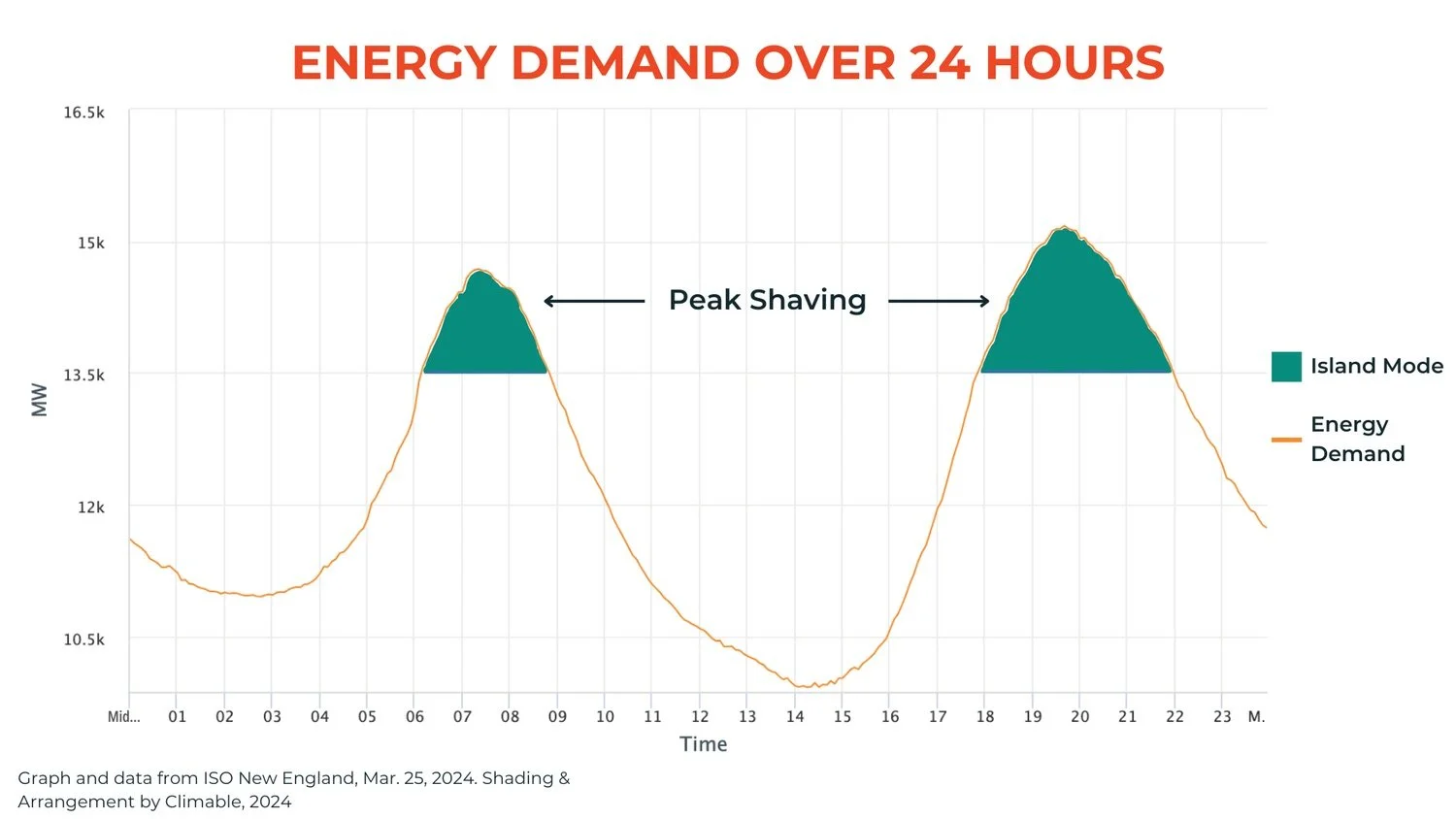
This graph shows energy demand on the grid in the New England region over 24 hours, depicted by the orange line. The green shading shows the potential “peaking shaving,” or overall demand reduction, when a microgrid is in island mode. Graph arranged by Climable, 2024.
What are the Challenges to Microgrid Development?
-
The upfront costs of microgrid components like solar panels, batteries, and the control system are extremely high and unaffordable for low and moderate-income households. Investors are often hesitant to fund community microgrid projects because the technology is still relatively new and they can’t guarantee their investment will be repaid. Estimating the monetary benefits of resilience and energy reliability is challenging, so there is little motivation to invest funds into such projects.
-
In order for microgrids to send and receive energy to and from the grid, they must be connected by a single point to the distribution lines of the grid, called “interconnection.” Local utilities must approve interconnection and sign an Interconnection Service Agreement (ISA). ISAs ensure that technical standards are followed to maintain safety and reliability when a microgrid connects to the wider network. However, developing an ISA involves lengthy and costly technical reviews. If you’re curious, you can read Eversource’s ISA here.
Additionally, Utility Franchise laws mandate that only electric utility companies can connect buildings with different owners to one another. Buildings on a college campus or military base, owned by the same owner, can be physically connected by wires in a microgrid. However, under Franchise Laws, two apartment buildings owned by different individuals or companies cannot be combined unless a utility owns the microgrid. This is where the virtual component of Climable’s microgrids comes in handy. The virtual controller connects all the other components via the cloud software system, rather than physical wires.
-
Many requirements must be met before microgrid components can be built. To install solar panels on buildings, rooftops must meet certain criteria. They must be mostly flat and not shaded by trees or other buildings so the maximum amount of sunlight can reach the panels. They also need to be strong and sturdy enough to support solar arrays throughout their typical 20-year lifespan. Any major planned renovations must be done before the solar panels are installed because panels can’t be removed and reinstalled at a reasonable cost. The size and space of roofs also influence the capacity of a solar array—the bigger the roof, the bigger the array. If your roof is too small for an adequate number of solar panels for the size of your building, then it won’t be worth installing them.
Batteries also have several requirements that must be planned around. According to fire codes—requirements for fire safety—batteries must be installed on the ground floor (“at grade level”) and a certain distance from surrounding buildings. This makes it difficult to find an appropriate location in dense urban areas. Additionally, before installing any equipment or undergoing any microgrid process, technical experts must perform an in-depth feasibility study that evaluates if the microgrid will meet all the legal and safety requirements.