
Grid Congestion: A Billion Dollar Problem
by Maeve Hulsman-Wells
The US is overdue for an energy overhaul. Reliance on fossil fuels has damaged the Earth and left animal and plant life vulnerable to extinction. A transition to clean, renewable energy sources like solar and wind would improve the outlook for our planet. But our grid isn’t prepared for a shift, leading to grid congestion—a billion-dollar problem.
The grid is a web of interconnected transmission and distribution lines that move power from generators, like power plants, to electricity consumers. As the US integrates renewable energy, the amount and the distance power travels through the grid are greater than its capacity to handle. Thus, grid congestion occurs when the energy gets stuck, damaging the grid and causing blackouts.
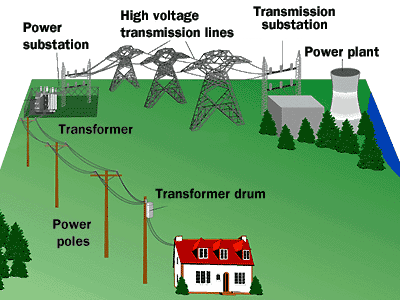
A simplified power grid. Image: Marshall Brain, Smith College
Congestion is problematic chiefly because electricity is critical to maintaining essential services, including air conditioning, which has become even more important in recent years. Additionally, when the grid is congested, the utilities supplying power must divert electricity from more expensive sources, costing consumers an estimated $20.8 billion in 2022 alone and projected to increase through 2023 as electricity demand rises.
The American electricity grid is old, built around fossil fuel resources, where transmission lines carry power from power plants to consumers. Renewables generate electricity far from where it’s used, meaning the electricity travels further. But, to meet climate goals, renewables must be dramatically increased, causing more congestion. This point has been capitalized upon, politically, to deny the necessity of clean energy development. In the end, Americans will suffer from this loss, so solving grid congestion is a priority.
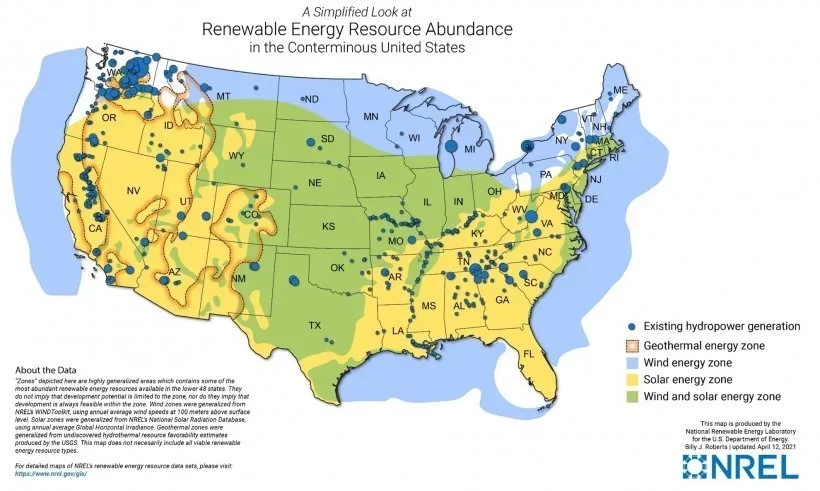
This is a map of the Renewable Energy Potential in the US. Wind energy potential, in particular, is found in some difficult-to-reach areas.
Ideally, one improves an overtaxed grid by improving interconnection – expanding the number and range of the high-voltage transmission lines that ferry energy from its source. Using grid-enhancing technologies (GETs)—a form of retrofitting—would also help the grid function more reliably. One GET option is reconductoring, where existing transmission lines are restrung with more efficient cables that can deliver more energy.
Many proposed solutions fall to political barriers. Building high-voltage transmission lines is difficult because of the number of stakeholders involved—private landowners, federal, state, and local regulations, tribal input—and the number of legislative and regulatory hoops developers must jump through. The body of legislation governing interstate construction is huge, so permitting for these projects can take years. Even GETs are difficult to achieve: utilities' business models make the return on investment much higher for larger projects, like grid expansion, than for updating existing portions of the grid, leaving it financially difficult to incentivize investment in GETs.
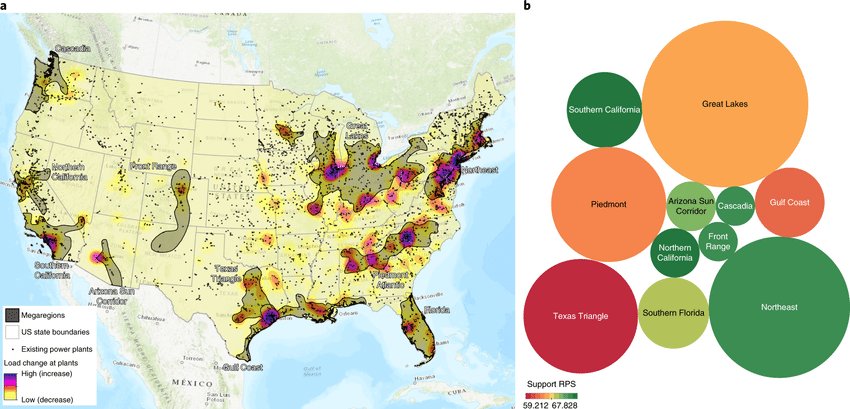
Projected grid congestion increases over the next 35 years. The Northeast and the Great Lakes region are projected to experience higher levels of grid congestion under the current grid capacity.
Support for expanded renewable power generation remains high, meaning congestion will increase without improvements to the grid's capacity. The federal government allocated money from the Inflation Reduction Act to expand the grid, and, more recently, the Federal Energy Regulatory Commission passed a set of reforms to streamline the permitting process necessary for interconnection. These efforts acknowledge the system-wide weaknesses in the grid. With the imminent threat climate change and major weather shifts pose to American households, industry advocates report that more short-term solutions are needed, which are yet unclear.