
Ancient AC
by Elana Manasse-Piha
Let’s talk about wind catchers! This architectural feature sustainably regulates a building’s temperature. They are tall, chimney-like structures that catch and funnel air currents. They have multiple long and narrow vertical openings on the top portion(s) of one or more of their walls and internal partitions to separate incoming and outgoing air currents.
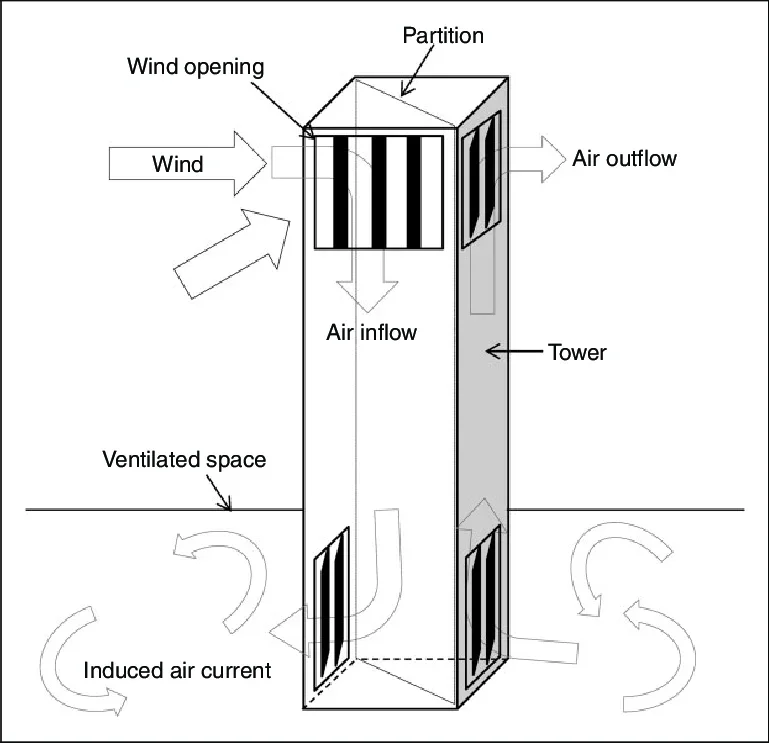
Basic wind catcher design. The vertical openings catch cool breezes that blow at higher elevations and funnel them down into the building. The denser cool breezes displace the less dense hot air (go, thermodynamics!). The displaced hot air will then rise out of the building through openings on the opposite side of the wind catcher. Or, if the wind catcher only has vents on one of its faces, the exhaust air exits through an opening elsewhere in the building. Source: Radwan M. Kassir.
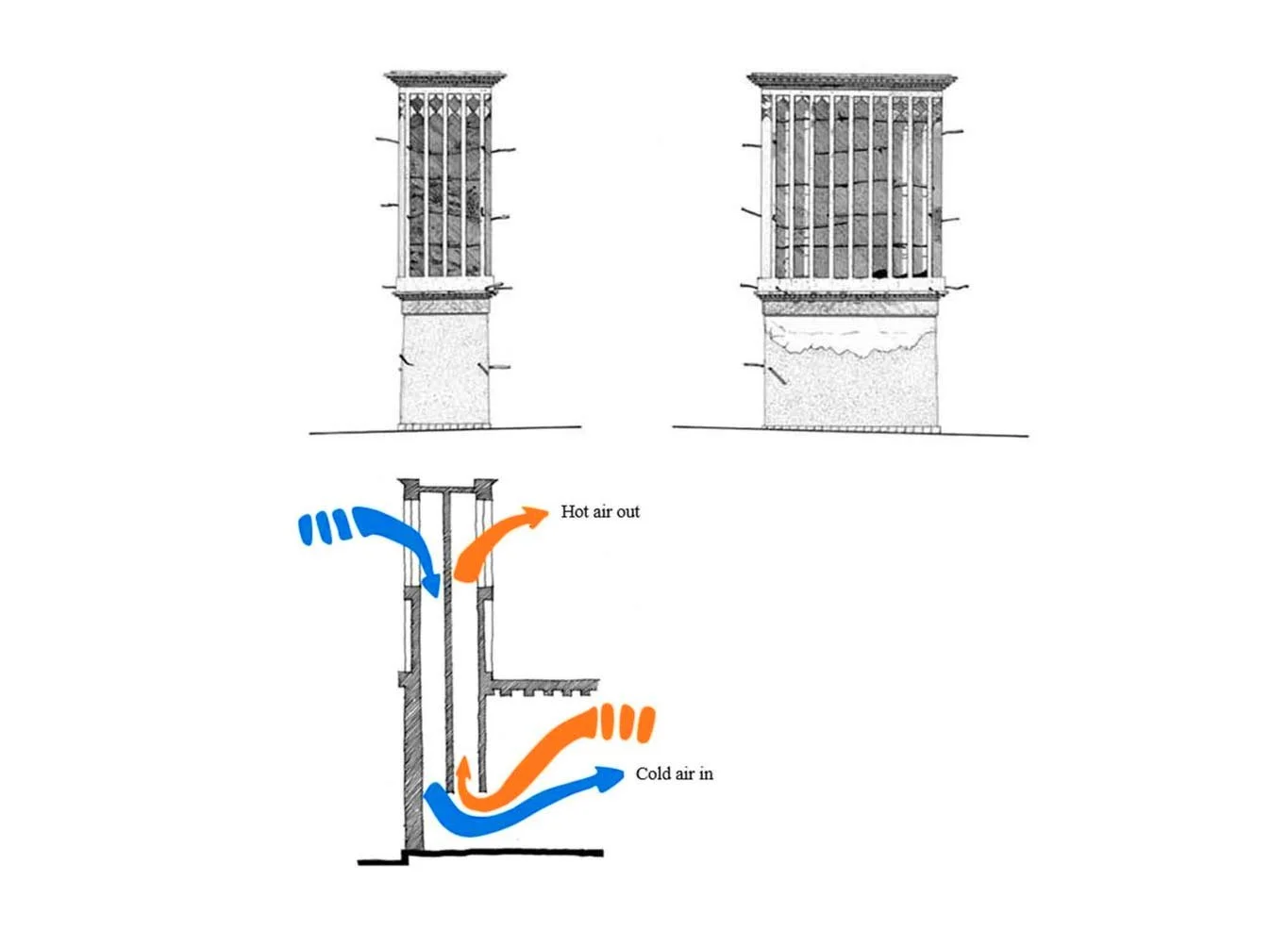
Wind catcher airflow. Source: SurfIran.
Wind catchers come in diverse shapes to accommodate differences in wind conditions and aesthetic tastes. They can be rectangular, hexagonal, octagonal, or even circular. Additionally, they can have inlets for air on one, multiple, or all of their faces. Wind catchers in Maybod, Iran, have only one inlet to prevent the harsh, dusty desert wind that blows in from the North from entering the house. Contrastingly, Yazd, Iran, a city about 55 km from Maybod, is surrounded by mountains that block the dusty desert winds. Wind catchers in Yazd tend to be multi-directional: rectangular, hexagonal, or octagonal, with inlets on each side to capture air currents from any direction.
Even when there is no breeze, a windcatcher keeps its building cool. Differences in temperature throughout the tower and building create a pressure gradient that causes warm air to rise up and out of the building through the wind catcher and cooler air to sink into the building. This process leads to air circulating through the building and is called a convection cell. (This is the same natural phenomenon covered in our recent post about how termite mounds have a central chimney that regulates the temperature inside the termite nest.)
Although the year and location of their invention are the subjects of much debate, wind catchers are unmistakably ancient. The writings of Nasir Khusraw, a 5th-century Persian poet, mention wind catchers, so we know they were in use at least 1,500 years ago. Going back even further in history, paintings discovered near Luxor, Egypt, dating to around 1300 BC, depict structures that appear to be wind catchers, suggesting an Egyptian origin. But, tantalizingly, the ruins of a Persian temple, dating to 4000 BC, were found to have many chimney-like structures, some of which had no traces of ash. This archaeological discovery insinuates wind catchers originated in Iran over 6,000 years ago!
Many factors, including placement, design, the height of the wind catcher, climate, building materials, and the size of the building in relation to the size/number of wind catcher(s) can contribute to their effectiveness. A case study in Nagapattinam, India, showed that a wind catcher could reduce the temperature in a house by 11 °F. A separate case study showed that a wind catcher could reduce indoor air temperature by 19.8 °F!
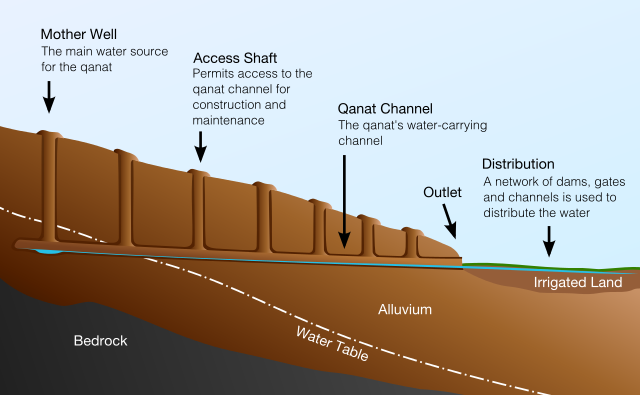
The effectiveness of wind catchers can be enhanced by using another ancient technology, qanats. Qanats are artificial underground aqueducts that accumulate and distribute fresh water from subterranean aquifers. Because they are underground, qanats prevent water from evaporating in harsh desert environments. So, in arid lands, they are an ideal way to transport water to a community or irrigate croplands.
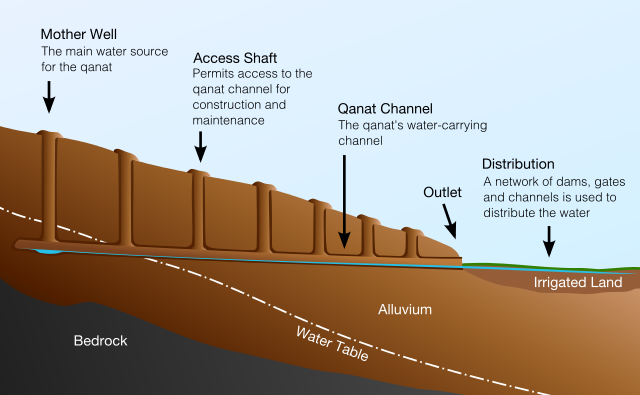
A Qanat.
Some homes and buildings with wind catchers have access to a qanat through an underground basement or cellar. When wind catchers and qanats are combined, they harness the force of evaporative cooling. Evaporative cooling is the reduction of temperature due to the evaporation of a liquid. When the air from the wind catcher meets the water from the qanat, it is cooled even more due to evaporative cooling.
Studies show that when wind catchers are paired with qanats, they can drastically reduce indoor temperatures. One study in Yazd, Iran, on wind catchers with qanats showed that they reduce indoor air temperature by up to 27°F! Another study in Ouargla, Algeria, showed that wind catchers supported by qanats increased relative humidity by 62.6% and decreased temperature by up to 33.48 °F!
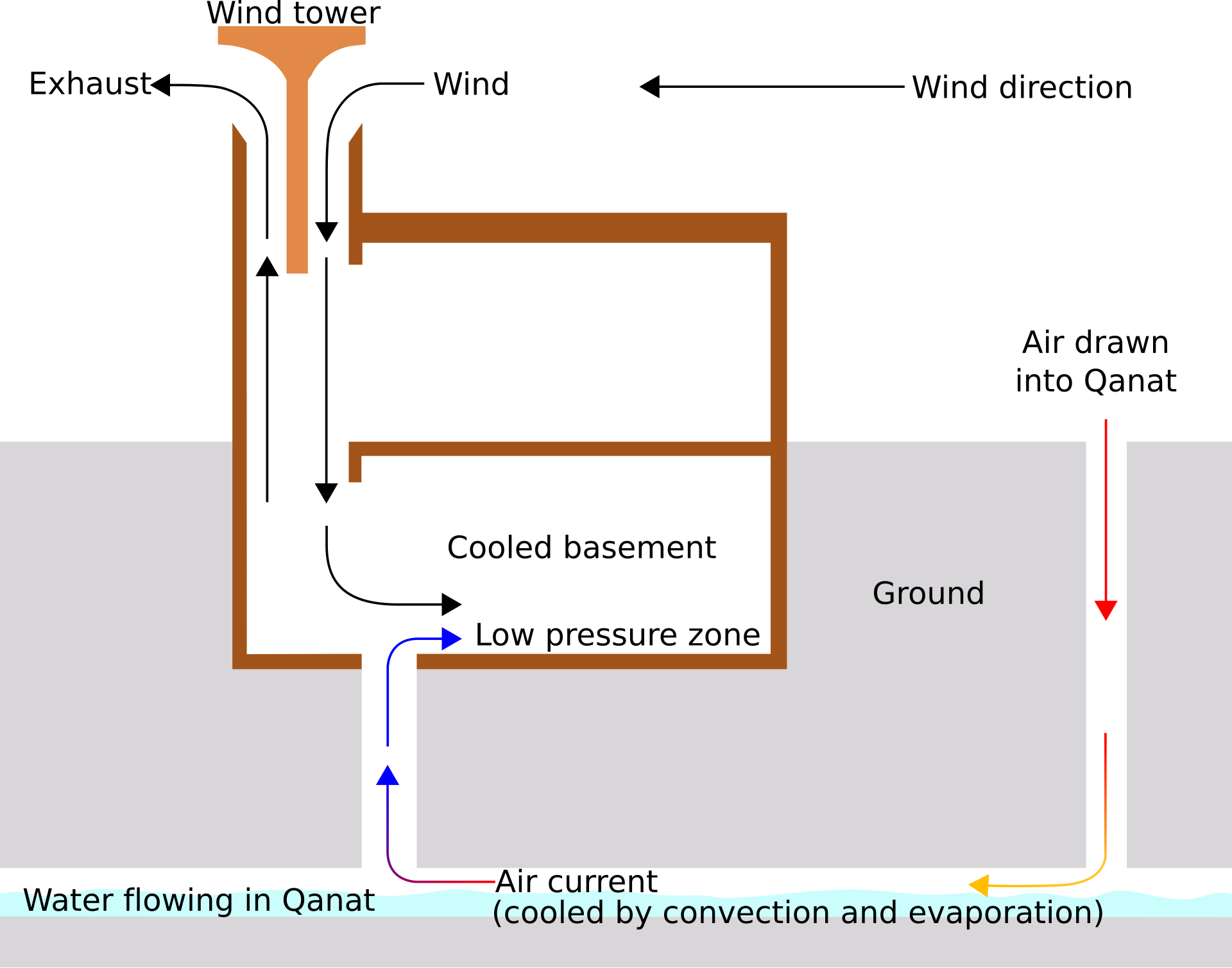
Configuration of a wind tower paired with a qanat. Source: Wikimedia Commons/cc
Wind catchers are still used today. In fact, over a 15-year period, over 7,000 wind catchers were installed in modern UK public buildings. Modifications and additions have been developed to enhance this passive cooling system. For example, one modern wind catcher uses solar-powered fans to increase their efficacy. Another type of modern wind catcher integrates evaporative cooling to boost its cooling capacity. Technology is still improving, and research is being conducted to optimize wind catcher design to make them even more efficient and suitable as an alternative to conventional air conditioning.
Buildings with wind catchers have the added benefit of always having a constant flow of fresh air. Studies have shown that having fresh air in a building promotes cognition and productivity and reduces environmental triggers for asthma and allergies. We know the continued use of traditional air conditioning is not sustainable. The more we use it, the hotter the planet will get, and the more we need air conditioning. Luckily, there are solutions. From the Montreal Protocol to buildings inspired by termite mounds, we have options. These are only a few examples of the many inventive alternatives to conventional air conditioning that would have a substantial impact if implemented worldwide.
What alternatives to conventional air conditioning do you think have the most potential? Let us know in the comments!